
Case No. COMP/C-3/39.740, COMP/C-3/39.775 & COMP/C-3/39.768 – The 2.42 Billion Euro Google Order.

P034802000402-605061


So it’s finally out, and boy is it big !! Well….actually….For Google(Somehow, still can’t bring myself to call it Alphabet. The word is so synonymous with the search engine since times immemorial), monetarily, it’s probably small. 2.42 Billion Euros is peanuts for the Internet behemoth. But what does matter to it is the impact this is going to enough on its products and services not just in the E.U., but throughout the world, which is why it is safe to bet that the company is going to all the way up to the E.C.J. if it has to. Fighting it out is already a forgone conclusion.

So, the following is my preliminary understanding of the Order. Please note though, that the complete text of the Order is not yet out, and so my preliminary opinion is based upon the Press Release, the Fact Sheet, and the Timeline of the case.:


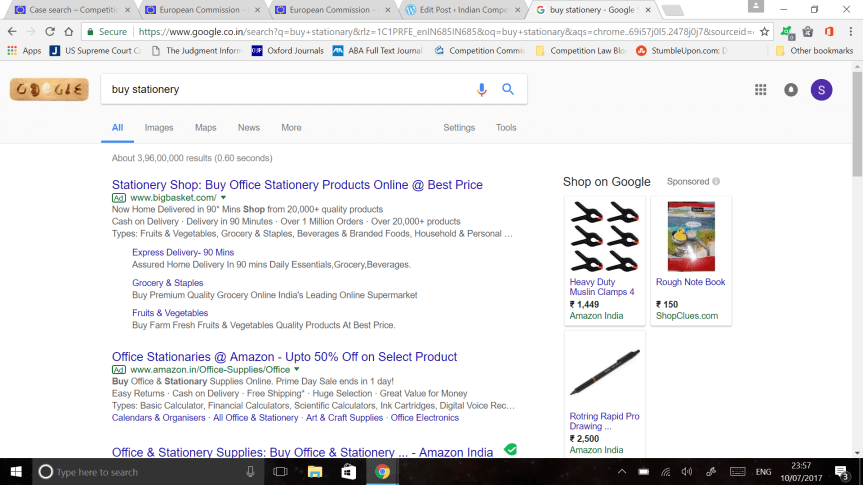
1. The case concerns the display of products on a service called Google Shopping. Now since this service has not been rolled out in India till now, I have never personally had a chance to use it, but from what I have to come to understand (and do feel free to correct me if my understanding is wrong), the product “allows consumers to compare products and prices online and find deals from online retailers of all types, including online shops of manufacturers, platforms (such as Amazon and eBay), and other re-sellers.” (Update: Okay so I just realised that the words typed matter. They must indicate ones intent to purchase a product. So the service has been rolled out in India, but after some experimentation, the results appear to be limited.)
Google Shopping 1


Google Shopping 2

Google Shopping 3

Google Shopping 4

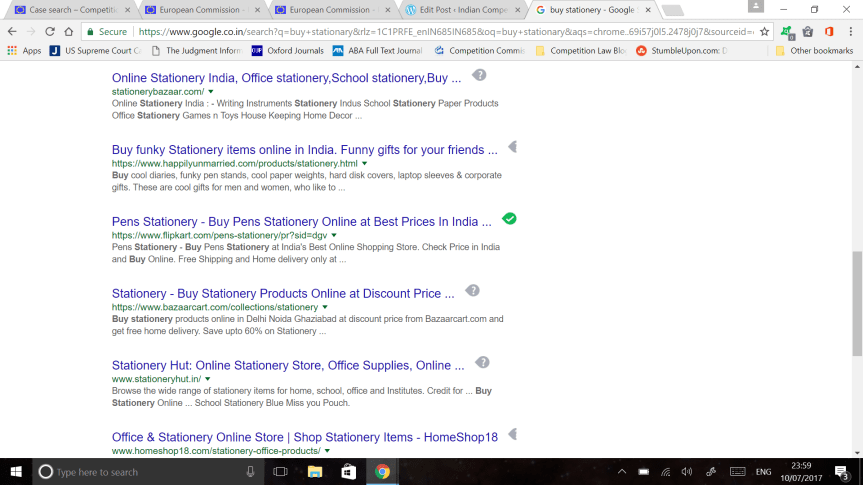
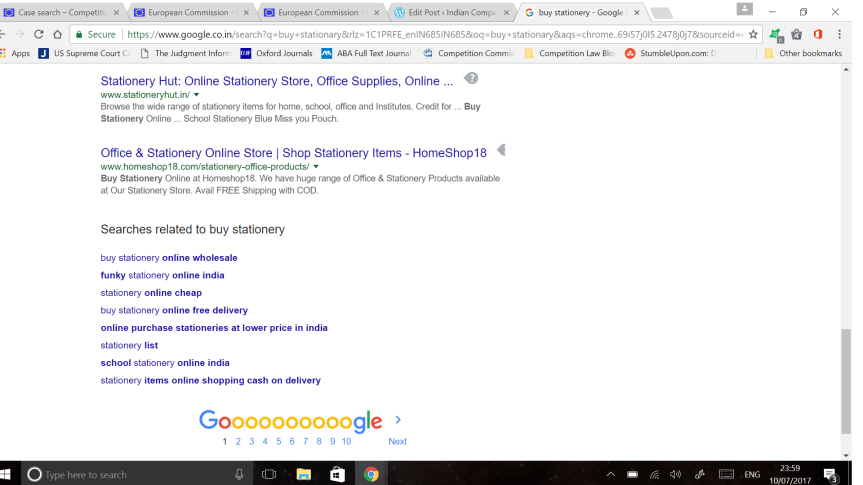
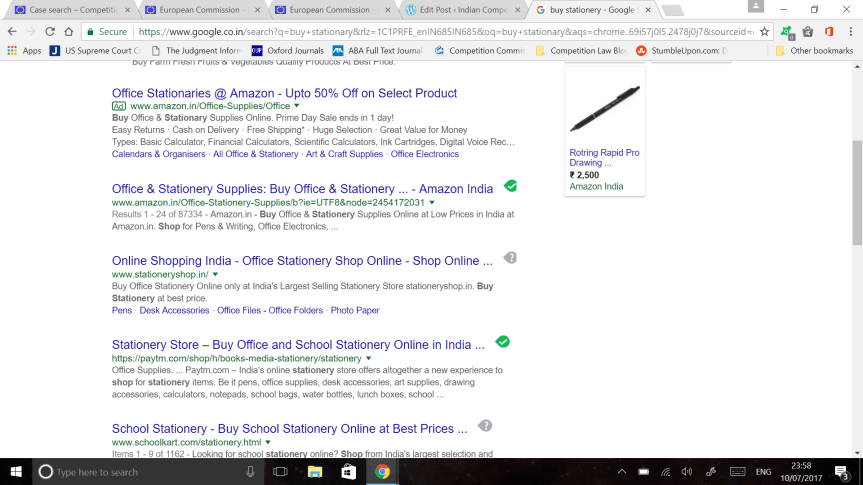
(Above: Google Shopping India: Personal experience on experimentation.)

2. From the above, the relevant market as per the Commission appears to be that of “shopping comparison websites/services”. The question to ask is, is there really such a definitive market in existence ?? Somehow, no matter which way one tries to describe it, it appears to be hard to cogently define it. After all, comparison of products can be done through the regular search, or they can be done through the individual websites, or they can be done through individual Applications (in the case of smartphones). Personally, I hardly used the Google results which appeared on the side. I (and perhaps many others) end up directly clicking on the “trusted/preferred” website (Amazon India, Flipkart, Ebay.in) and search directly for the product by jumping between these sites (not to mention to multiple options available on each individual website). It’s important to note that these website results do almost always come up among the top five to ten results on the first page, hence the lack of use of the Google Shopping. (See the pictures above as an example)

3. The fundamental premise of competition law, both in India as well as the E.U., is that any appreciable adverse affect on competition in the relevant market or abuse of dominance results in a harm to consumers. In the present case, however, was Google Shopping really so bad ?? Is there really an adverse affect on competition or an abuse of dominance ?? As already stated, the results which pop up under Google Shopping (which, it must be noted, are clearly differentiated),  are merely the most relevant websites where you would find the product. And consumers do appear to be have A LOT of choice in the alleged relevant market. So even if the sponsored results do pop up on the side, does it really hurt anybody at all ?? In fact, from the Press Release, it appears that even the Commission is not sure if there is any actual detrimental affect on consumers, but rather only states “Google’s comparison shopping service [sic] make[s] significant gains in traffic at the expense of its rivals and to the detriment of European consumers.” A rather vague statement, but then, that may be because it is only a Press Release.

Google’s troubles in Europe are far from over. The Android Operating System and the Adsense cases are still pending, and the trend appears to be against the company. The three cases together could well become the triumvirate against what was once considered (and arguably still is), the most innovative company in the world.

And Here We Go Again….

download


The European Union has launched a fresh salvo against Google, this time charging Google with abusing its dominance in Internet searches and opened a probe into its Android mobile system.


The E.U. Executive Commission has stated that it has found that Google “gives systematic favourable treatment” to its Google Shopping at the expense of others in its general search results.


Am pretty sure by the time the Google anti-trust investigation ends, one will be able to write an entire book on the company and its competition law troubles.

Is The Noose Tightening ??

download


Is the C.C.I. noose slowly tightening around Google ?? It sure does seem that way. The C.C.I. recently admitted another case against Google, and will probably club the Information with the ongoing investigation in the BharatMatrimony Case and the C.U.T.S Information Case. Speaking of BharatMatrimony and C.U.T.S., Google’s woes have risen with it being fined one crore for non-cooperation in the ongoing D.G. investigation.


So why is it facing so much difficulty in India ?? Probably because it may not be innocent after all. Not to express opinion on the merits of the case, but it is a fact that Google hasn’t exactly won any of the competition law cases filed against it across the world. Both the E.U. investigation and F.T.C. investigations were closed with settlements, which one can’t exactly count as a victory. All Google did was make certain commitments to the two bodies and consequently changed their programming to suit the settlement. It can’t do that in India, there being no provision for settlement/compromise of cases in the Competition Act, 2002. In fact, Google has lost a case against it’s Adwords programme in Australia, which has probably bolstered the hopes of those who feel discriminated by Google Adwords.


People may believe that I am against Google, considering how much I write about it (and according to many, against it). Rest assured, one could not be farther from the truth. In fact, I am one of Google’s biggest fans, but more on this later in another post which I have planned.


Why the CCI Google Investigation faces Difficulty.

A recent Economic Times Article states that the “probe by Indian authorities to examine if Google abused its dominant position in the Internet search engine market is progressing at a sluggish pace, mainly due to a lack of understanding on Internet-related issues.” Furthermore, it also stated that “India (presumably through the C.C.I.) has sought the FTC’s help in this matter.”

While the reason stated above is probably true, I feel another important reason the investigation faces difficulty is becaue of the direction the D. G. Office seems to be taking to reach its goal. This is evident from the second line quoted above, where the article states that the C.C.I. is looking for aid from the F.T.C. There is no harm in asking for aid from others, but in this case, the Commission may be asking for aid from the wrong people. One needs to understand that the F.T.C. and the European Commission have SETTLED their cases with Google on the basis of certain commitments they received from the company. (See here for the F.T.C. commitments and here for the E.U. commitments). It is more than evident from their respective press release and the commitments received from Google that both the competition authorities never approached the investigation with an intention to prosecute. Their primary intention was merely to ensure competitiveness without disrupting the market (being the internet search engine market and online advertisement market) to the best possible extent. The merits of such an approach are of course debatable, but are presently outside the scope of this post. What is important is that settlements require a mediative approach (far different from an adjudicatory approach) and this is not the approach the C.C.I. wishes to follow. Even if it wishes to, it as of now can’t, as explained in a previous post.

It is better if the Commission looks eastwards to the Australian Competition and Consumer Commission (A.C.C.C.) for help. The judgement of the Federal Court of Australia is the only case which Google has lost on allegations against its Adwords programme, which is the primary subject of investigation even in India.Google-confused

Google and its Anti-Trust Woes (An Update on the EC Investigation)

Joaquín Almunia, Vice President of the European Commission responsible for Competition Policy on 21st May released a statement on the Google investigation. (Agree this is a rather late update. Unfortunately, missed it due to examinations).

In it, he has highlighted four concerns against Google which are as follows

First, in its general search results on the web, Google displays links to its own vertical search services. Also, Google displays links to its own vertical search services differently than it does for links to competitors.The Concerns of the EC are that this may result in preferential treatment compared to those of competing services, which may be hurt as a consequence.

Second, concerns related to the way Google copies content from competing vertical search services and uses it in its own offerings. Google may be copying original material from the websites of its competitors such as user reviews and using that material on its own sites without their prior authorisation. In this way they are appropriating the benefits of the investments of competitors.

Third concern relates to agreements between Google and partners on the websites of which Google delivers search advertisements.

The fourth concern relates to restrictions that Google puts to the portability of online search advertising campaigns from its platform AdWords to the platforms of competitors.  The concern is that Google imposes contractual restrictions on software developers which prevent them from offering tools that allow the seamless transfer of search advertising campaigns across AdWords and other platforms for search advertising.

On a related note, notice that the statement is conciliatory in nature, which Joaquín Almunia himself stating, and to quote

“I offer Google the possibility to come up in a matter of weeks with first proposals of remedies to address each of these points.”

This is not a new phenomenon in competition investigations and it it is one which the CCI itself should begin to adopt. It saves time and prevents unnecessary and lengthy litigation. The logic in this case (though it may differ on the circumstances of each case) is that despite their their potential anti-competitiveness, it must be universally accepted that Google products are in general extremely beneficial to its users, and thus any changes forced upon Google, while they may or may not ensure a competitive marlet, shall in all probability harm consumer welfare till a certain extent. (This is one of the issues underlined by  Robert Bork in his competition law classic The Antitrust Paradox: A Policy at War with Itself. A must read for all those with a special focus of interest in competition law.)

Legal Analysis of Google’s AdWords Programme and its Conflict with Indian Competition Law (An Update)

Please click here to see an update on the previous post.