National Seminar on “Trade Associations and the Indian Competition Regime – Compliance Issues”

PHD House, August Kranti Marg, New Delhi, 9/6/2013 12:00:00 AM

The seminar will dwell on why is competition law compliance important for Trade Associations, what type of conduct does competition law regulate, what are restrictive agreements or concerted practices, abuse of a dominant position & How to comply with Competition Law.

Organized by PHD Chamber of Commerce and Industry jointly with Society of Indian Law Firms on Friday, 6th September 2013 at 03:45 P.M. at PHD House, 4/2 Siri Institutional Area, August Kranti Marg, New Delhi.

Details can be sought from shikha_s@phdcci.in / kirti@phdcci.in. Entry will be confirmed with prior registration only.


Source: S.I.L.F. Release

Training Program on Competition Law by N.U.J.S.

nujs

N.U.J.S., Calcutta is organising a training Program on Competition Law from 14th August, 2013 to 17th August, 2013.

Seats are limited to thirty and applications shall be accepted on a first come, first serve basis.

Further details can be found here

Source: Lawctopus

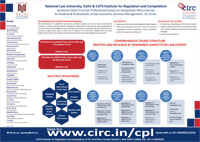
Certificate/Diploma Courses on Competition Policy and Law (2013)


CPL-Poster


The Certificate / Diploma Courses on Competition Policy & Law are back !! The last date for registration is 31st July, 2013.


Jointly taught by C.I.R.C. and N.L.U.D., “the courses, duly accredited by the National Law University, Delhi, are designed to deliver knowledge and skills relating to Competition Policy and Law to the participants and open up new employment opportunities in Competition Authorities, Regulatory Bodies, Law Firms, Businesses, Research Bodies, etc.”


Click here for further details.

International Conference On Interface Between Intellectual Property And Competition Law

images (2)

ASSOCHAM is organizing an International Conference on Interface between Intellectual Property & Competition Law on 12th July 2013, at New Delhi.
For details and registration, please see here.
P.S.: It seems ninety five percent of all competition law conferences happen in Delhi. Not surprising of course, with the C.C.I. and COMPAT in Delhi
 

Competition World (By Norton Rose)

I recently came across a Newsletter/Bulletin published by Norton Rose in May 2013 titled “Competition World: A Global Survey of recent Competition and Antitrust Law Developments with Practice Relevance.” I haven’t had the chance to read the full document, but a quick glance made it out to be an excellent summary on all the key competition law developments around the world. Though the Bulletin primarily focuses on the E.U., it also notes developments in Africa, Asia, America and Australia.

P.S.: For the record, this is not a sponsored post.

Upcoming Conferences.

We have two upcoming conferences which should be of great interest to our readers:

1. ANTITRUST IN ASIA: DEVELOPMENTS IN INDIA’S COMPETITION REGIME.

Dates: November 30, 2012 – December 01, 2012

Venue: The Taj Mahal HotelNumber One Mansingh Road, New Delhi –  110011

Being organised by the American Bar Association’s Section of Antitrust Law, “for antitrust practitioners in India, this conference will present a great opportunity to interact with CCI officials and top antitrust lawyers from the U.S., Europe and Canada, as well as to learn more about recent developments in antitrust enforcement in North America and Europe.”

2. COMPETITION LAW ENFORCEMENT AND BUSINESS STRATEGY

Date: November 29, 2012

Venue: PHD House, New Delhi

Being Organised jointly by the CUTS Institute for Regulation and Competition and the PHD Chamber of Commerce & Industry, the seminar “is designed to throw light on CCI’s role and its success and challenges, cross border  M&As in pharmaceutical sector and its challenges, competition issues in platform markets/network industries apart from focusing on importance of competition reforms in developing countries.”

Supporting And Growing Our Premise

In our post titled “Executive Actions And Indian Competition Law:A Premise”, we tried to develop a premise on when the executive actions may be considered anti-competitive under the Competition Act. In an attempt to grow on that post, a recent article in Mint titled “Ending India’s Food Cartels helps us to further stress on the point in the above post. The article focuses on the monopoly of the Food Corporation of India (FCI) and the Agricultural Produce Marketing Committees (APMC’s).

While I do not entirely agree with the article ( APMC’s cannot be considered for anti-competitive practices, the reasons for which please read the previous posts and “hoarding” by the FCI is forgetting the fact that the FCI is also the organisation to manage the buffer stocks of the country), I do feel there may be a case against the FCI with regards some of its procurement policies. However, only a detailed in-dept investigation can reveal more.

Executive Actions and Indian Competition Law: A Premise

In one of our previous posts, I had tried to highlight that a regulatory authority of the government could not in most cases be challenged as anti-competitive or an abuse of dominant position. Using the facts of that particular case, I had tried to show that in most cases such authority of a ministry or a sub-division of the ministry could not be challenged.

To grow upon that post, I submit the Commissions order in Arshiya Rail Infrastructure Ltd. (ARIL) vs Ministry of Railway (MoR) & Ors.  (Main Order/Per S.N. Dhingra, Member/Per M.L. Tayal, Member/Per R. Prasad, Member (Dissenting)) is one of the few cases where executive actions could be challenged as anti-competitive. While once again the Commission dismissed the case on merits, the Order helps in clarifying the Commissions stand regarding this issue and consequently, also helps us to update our previous premise to as follows:

1.   Exercise of executive authority through regulations or rules issued by an executive authority for the purposes of regulation of the provision of any goods or service cannot by itself be considered a service on the part of the Government.  It is merely the exercise of the legitimate state authority, and thus cannot be challenged as anti-competitive or an abuse of dominant position.

2. Any action of such a government authority when  a subdivision of that ministry or authority ( in this case, the Indian Railways) wherein the ministry or executive authority’s position results in a DIRECT relation as a competitor in the relevant market may be challenged as anti-competitive or an abuse of dominant position as the ministry or its sub-division would end up coming under the ambit of the definition of “enterprise” under Section 2(h) of the Act and thus could also be interpreted under the definition of “group” as given under clause (b) in the Explanation to Section 5.

We welcome your comments, criticism and feedback on the above premise.