C.C.I./T.R.A.I. and Flashbacks to Old Posts

collage-inside-CCI-TRAI-1

The recent C.C.I. – T.R.A.I. jurisdiction conflict regarding tariff investigations reminded of an old post which was written a long time ago. Those were very early days for the Competition Act and the C.C.I., but a theoretical conflict was spoken off even then. Personally, I find it surprising that it took so long for a dispute between the two to come to the fore, but without a doubt, sooner or later, it was bound to rear its head.

The old posts can be found here and here. I have nothing more to add, except factually, the C.C.I. appears to have failed to hold its own in Court when it’s jurisdiction came to be challenged regards the C.E.R.C. and the P.N.G.R.B. The P.N.G.R.B. Case was pending even at the time the previous posts were written, but subsequently fell below the radar. Surprisingly, neither of the Judgements (the C.E.R.C. Case or the P.N.G.R.B. Case) can be found. Please do post a link in the comments in case you find them or have access to them.

Case No. COMP/C-3/39.740, COMP/C-3/39.775 & COMP/C-3/39.768 – The 2.42 Billion Euro Google Order.

P034802000402-605061


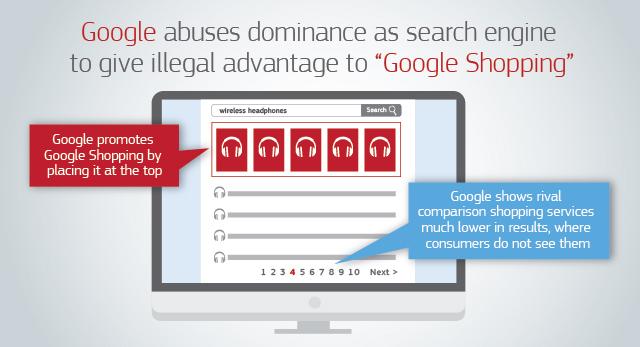
So it’s finally out, and boy is it big !! Well….actually….For Google(Somehow, still can’t bring myself to call it Alphabet. The word is so synonymous with the search engine since times immemorial), monetarily, it’s probably small. 2.42 Billion Euros is peanuts for the Internet behemoth. But what does matter to it is the impact this is going to enough on its products and services not just in the E.U., but throughout the world, which is why it is safe to bet that the company is going to all the way up to the E.C.J. if it has to. Fighting it out is already a forgone conclusion.

So, the following is my preliminary understanding of the Order. Please note though, that the complete text of the Order is not yet out, and so my preliminary opinion is based upon the Press Release, the Fact Sheet, and the Timeline of the case.:


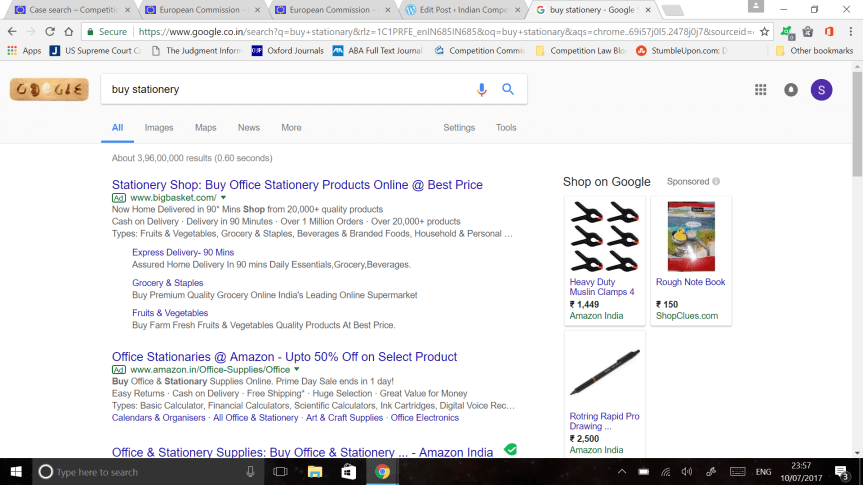
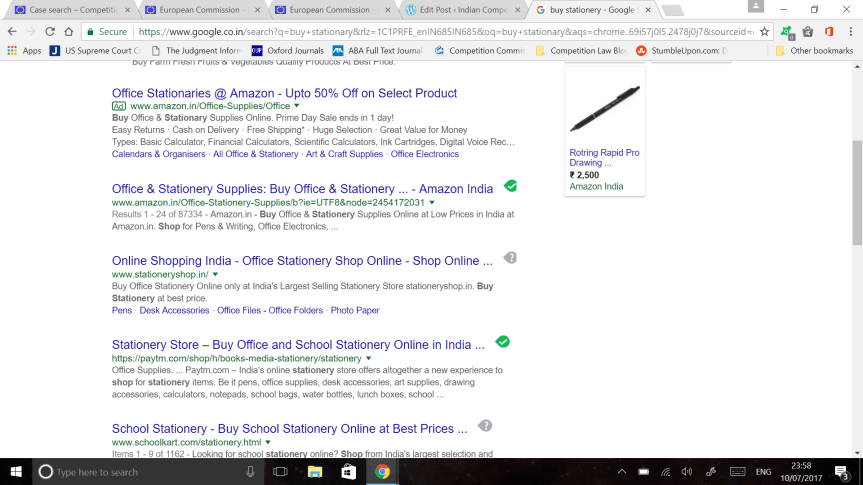
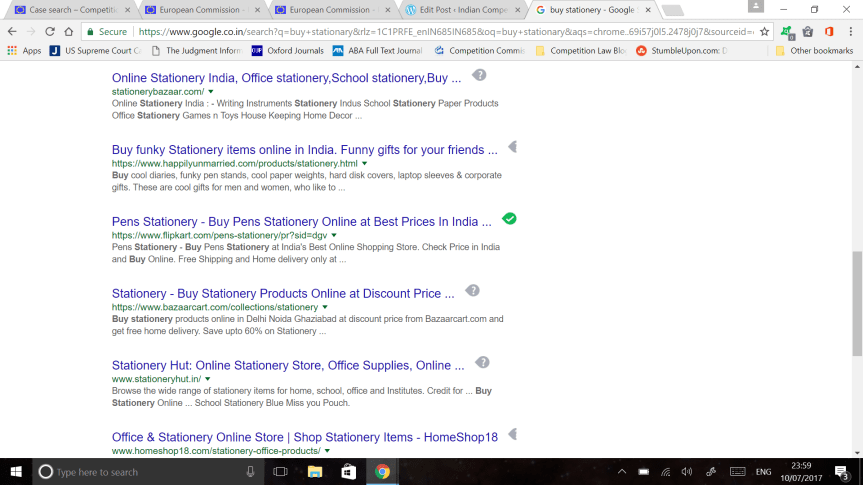
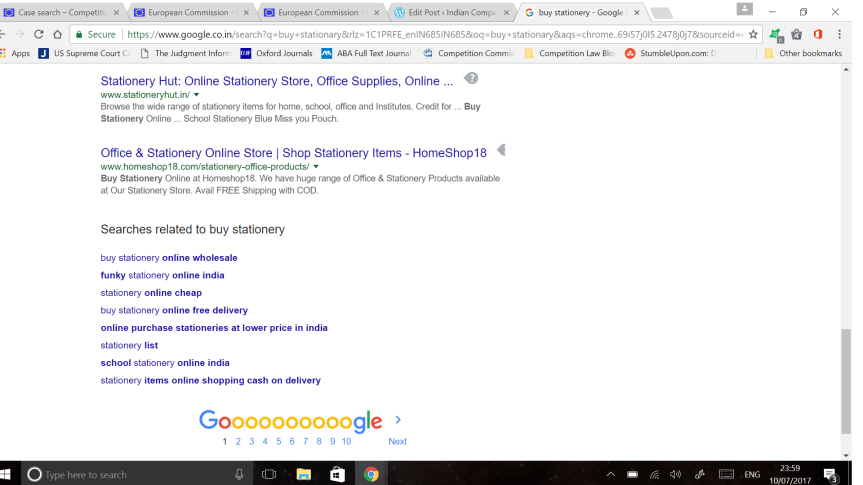
1. The case concerns the display of products on a service called Google Shopping. Now since this service has not been rolled out in India till now, I have never personally had a chance to use it, but from what I have to come to understand (and do feel free to correct me if my understanding is wrong), the product “allows consumers to compare products and prices online and find deals from online retailers of all types, including online shops of manufacturers, platforms (such as Amazon and eBay), and other re-sellers.” (Update: Okay so I just realised that the words typed matter. They must indicate ones intent to purchase a product. So the service has been rolled out in India, but after some experimentation, the results appear to be limited.)

Google Shopping 1


Google Shopping 2

Google Shopping 3

Google Shopping 4

(Above: Google Shopping India: Personal experience on experimentation.)

2. From the above, the relevant market as per the Commission appears to be that of “shopping comparison websites/services”. The question to ask is, is there really such a definitive market in existence ?? Somehow, no matter which way one tries to describe it, it appears to be hard to cogently define it. After all, comparison of products can be done through the regular search, or they can be done through the individual websites, or they can be done through individual Applications (in the case of smartphones). Personally, I hardly used the Google results which appeared on the side. I (and perhaps many others) end up directly clicking on the “trusted/preferred” website (Amazon India, Flipkart, Ebay.in) and search directly for the product by jumping between these sites (not to mention to multiple options available on each individual website). It’s important to note that these website results do almost always come up among the top five to ten results on the first page, hence the lack of use of the Google Shopping. (See the pictures above as an example)

3. The fundamental premise of competition law, both in India as well as the E.U., is that any appreciable adverse affect on competition in the relevant market or abuse of dominance results in a harm to consumers. In the present case, however, was Google Shopping really so bad ?? Is there really an adverse affect on competition or an abuse of dominance ?? As already stated, the results which pop up under Google Shopping (which, it must be noted, are clearly differentiated),  are merely the most relevant websites where you would find the product. And consumers do appear to be have A LOT of choice in the alleged relevant market. So even if the sponsored results do pop up on the side, does it really hurt anybody at all ?? In fact, from the Press Release, it appears that even the Commission is not sure if there is any actual detrimental affect on consumers, but rather only states “Google’s comparison shopping service [sic] make[s] significant gains in traffic at the expense of its rivals and to the detriment of European consumers.” A rather vague statement, but then, that may be because it is only a Press Release.

Google’s troubles in Europe are far from over. The Android Operating System and the Adsense cases are still pending, and the trend appears to be against the company. The three cases together could well become the triumvirate against what was once considered (and arguably still is), the most innovative company in the world.

Indian Merger Control – 30 Days Sword Gone (And an Introduction :-))

Allow us to introduce Ms. Samali Verma, who will now join us on this Blog. She is presently pursuing a Judicial Clerkship at the High Court of Delhi and has extensive experience on the subject of our love prior to her present role. She plans to start with small snippets/updates and we soon hope to see larger posts from her over time. Welcome to the Blog, Samali. 🙂


download

In a significant development, the Ministry of Corporate affairs vide its notification dated 29.06.2017 has brought in a relaxation with respect to the time-period within which a merger/combination transaction is to be notified to the Competition Commission of India (C.C.I.).

This notification exempts an enterprise, from filing a notice within 30 days, for a period of five years from the date of the notification. The C.C.I. has now effectively done away with the earlier mandate which required filling within 30 days of a trigger event.

This is a much appreciated relaxation in the merger control regime in India. This change was long due, and now this finally puts India at par with the internationally accepted best practices in the merger control regime. It is expected to further increase the ease of doing business in India and is a welcome step, especially for those involved in multi-jurisdictional filings, as this removes the artificial pressure of having to comply with the 30 day deadline. The failure to give notice to the C.C.I. of a notifiable transaction may attract penalty, which may extend to one percent of the total turnover or assets of the combination.

Click here for a copy of the Notification.

Revival Time

download


Yes it’s been a long time since I updated this Blog. The reasons are a combination of excess work, exhaustion, ill health and lethargy.

It is time to break this hiatus. I have a tonne of ideas/ issues roiling in my head and there are just too many thoughts which need to be penned down. 🙂

Also, we might also be joined by a few more authors on this platform. More updates on that soon.

Certificate Course in Competition Law/ Advanced Professional Course in Competition Law and Market Regulation, 2016

iica5

“In a short span of about six years, enforcement of the Competition Act, 2002 has necessitated competition law to be taken seriously. Increasingly, greater number of organisations and individuals – both in Government and Private spheres – now need to acquire knowledge on competition law. These courses – Certificate Course and Advanced Professional Course – are uniquely designed and developed by IICA as shorter, flexible and focused option to meet specific professional needs of policy makers, regulators, business executives, lawyers, economists, CS, CAs and other professionals.

These Courses have now emerged as the gold standard in the area of competition law & market regulation on the merits of: rigorous course content and focus on specialised professional needs and easy of delivery. The hybrid mode of delivery – involving brief in-person sessions and regular online sessions on weekends – allows the participants to attend the course along with their professional pursuits. The modules – written and reviewed by top experts – offer clear and actionable knowledge. Similarly, interactions on live and past cases and practical situations with leading competition law experts from law firms and Government help the participants seek clarity on complex business and policy issues.

The 3-month Certificate Course in Competition Law (Certificate Course) entails study of Modules 1 to 3 (during February – May 2016). The Certificate Course has been designed for professionals, who wish to fully grasp the impact of competition law on business strategy, and development competence on competition law compliance.

The 6-month Advanced Professional Course in Competition Law and Market Regulation (APC), an add-on course to Certificate Course, aims to offer deeper view of advanced issues including economics for competition law, JVs, structuring complex agreements, multi-jurisdictional M&A filings, IPRs, public sector, regulated sectors, foreign jurisdictions, etc. The APC has been designed for professionals, who wish to develop specialization in competition law and market regulation or looking to re-skill or move into specialized areas. In addition to first three modules (Module 1 to 3), the advanced Modules 4 to 8, shall be offered to APC participants (during Feb – July 2016). While Module 4 is compulsory, participants of APC can choose any two specialized modules among Modules 5, 6, 7 and 8.

Candidates can choose to enroll for either a Certificate of Participation or Certificate of Successful Completion in a chosen Course. A participant is eligible to earn Certificate of Successful Completion only after passing the written examination. An International Immersion Visit shall also be conducted to provide international best practices.”

For further details, please see here.

T.R.A.I. Consultation Paper on Differential Pricing for Data Services (A.K.A.) What Has Now Become The Fight Over “Free Basics”. (Part – II).

Its-free


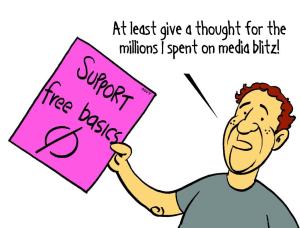
Now coming to the the Scheme which has been grabbing all the attention in the mass media, which includes news and paid correspondence !! Frankly, don’t remember the last time I saw the kind of advertising and media blitzkrieg which Facebook has released on the Indian public to promote “Free Basics”. The past week has been a mixture of multiple full page advertisements in all major newspapers giving us an insight into “what Network Neutrality Activists Won’t Tell You”, “A First Step Towards Digital Equality” and “Support Ganesh: Support Digital Equality”. Some of Facebook’s tactics displayed in full the desperation of the omnipresent social networking website as well as the gullibility of the Indian (atleast online) populace. Mark Zuckerberg has himself become part of the PR overdrive in order to push support for what he genuinely seems to believe should be the next big leap in connectivity in India.

Now lets get two facts straight at the very outset. There is NO DIFFERENCE between “Free Basics” and “Internet,org”. “Internet.org” was a failure because it generated too much unexpected negative publicity for Facebook and the websites/organisations joining the initiative. This led to most of them opting out of the service, which is why Facebook decided to re-christen the programme and to push it through this time they decided to also launch the “Free basics – Digital Equality” campaign in order to generate some public support for the Scheme. So far, it has been an expensive campaign with little to show for it, except for a lot (allegedly 3.2 million as per facebook itself) of virtual verbatim blind click mails and signatures which Facebook claims is the “support” they have received from the Indian online community. [UPDATE: The T.R.A.I. has now stated that it considers these mails/signatures as a valueless opinion poll and are not an adequate response to the questions framed by it.] Secondly, it would be most unfair to not acknowledge the fact that “Free Basics” has the potential to be beneficial to the citizens of India, especially the unconnected parts of the country. However, as I outline below, the Scheme as it’s terms and conditions stand today, are more harmful for internet connectivity in the Country than the ancillary benefits which may accrue.


FACEBOOK CONTROLS EVERYTHING ON FREE BASICS/INTERNET.ORG

It is Facebook which acts as a guardian of the gate who will decide who enters the Free Basics platform and who doesn’t. Frankly, I am not comfortable with one entity exercising such overarching controls over a programme which it aims to spread itself throughout the country, and further throughout the world. Make no mistake, philanthropy aside, there are two major reasons why Facebook actively pursues “Internet.org/Free Basics”:- One, more eyeballs for the advertisements generated on its website as new users sign into Facebook. Second, for the shear amount of data it will generate for analysis through its user-base. Facebook is at the end of the day a business and while it is natural for a business to want to expand its customer base and generate higher revenues/profits, this cannot come at a cost of taking advantage of an individuals lack of literacy or understanding of how expansive the internet really is and attempt to keep him or her confined to select websites which have “conformed” to the standards set by Facebook. In simple terms, Facebook has no right to act as a hand holding teacher and “guide” people through a particular path. People must be allowed to understand that the internet is more than what they will see through “Free Basics” and choose for themselves what they wish to do or see on it, whether it be researching on new farming techniques or even be as voyeuristic as watching porn. Don’t get me wrong. Am sure the “Ganesh” in the Full page newspaper ads must have genuinely benefited, but did he have any idea that what he saw was just perhaps two percent of the accessible internet ??

Let me substantiate this with a real life example of what is happening in poorer parts of the world. Millions of Facebook users have no idea they’re using the internet !! A research survey, with a special focus on Indonesia and Nigeria where surveys were carried out, displays how people were not aware about the internet, but yet used to directly access Facebook, to the extent that in opinion polls a higher percentage would state that they had accessed Facebook, but a lower percentage would state that they had accessed the internet !! And do note, the article discussing the findings is dated 9th February, 2015 and states that the trends were noticed three years ago, when “Internet.org” was merely a concept in discussion and roll out had not even started. Imagine what internet connectivity could become with “Internet.org/Free Basics” implementation at its peak ?!?!


THE PROBLEM IS NOT PRESENT ABUSE. IT IS POTENTIAL FOR ABUSE

As of now, Facebook has stated that it has never rejected an Application which fulfill’s the qualifying parameters for developers on “Internet.org/Free Basics”. That’s fine for now, but what about the future?? Is Facebook willing to give a commitment that the “parameters” will always be broad and will never be to the detriment of a genuinely useful Application for the people?? No it won’t, not because it may or may not want to, but because it can’t !! The engineers at Facebook are not oracles to see the future, and what can be good or not got good or worthy or not worthy to be accessed by the Indian internet community cannot be subject to parameters laid down at a single given point of time, no matter how broad they may be. This will always be subject to the ever changing values of any given society and furthermore, to the ever important evolution of technology which in today’s furiously paced world is not just extremely hard, but downright impossible to predict. Anybody could come up with a technology or programme to give Facebook a run for its money. Can Facebook give an absolute guarantee in writing that such an Application/Programme would be allowed on Free basics?? I highly doubt it. (You can already see a potential for such abuse relating to an upstart Facebook rival “Tsu.co”)

One look at the Reliance Free Basics website for details on the websites which as of today on the platform shows that only thirty one websites/Applications are part of the Free services available under “Free Basics”. The only social networking websites, no guesses required here, are Facebook and Facebook Messenger. Over and above this, the only search portal was “Bing”, the only Jobs portal was “BabaJob” (I hadn’t even heard or read of them before seeing them here) and the only shopping website was “OLX”. The result is a potentially serious anti-competitive scenario over the internet resulting


THE INTERNET IS NOT A BUSINESS. 

David Kirkpatrick, in a Linkedin Pulse Blog Post, is one of the few who has come out in defence of Facebook/Free Basics. He opined a marxist argument questioning in bold words “Do all these elite and generally upper-class and affluent Indian pundits, professors and anti-corporate activists have a better way to get many millions of less-privileged Indians onto the Internet?” and further goes on declare as follows:

“But in my view Free Basics is a fine example of what many call “doing well by doing good.” There is nothing wrong with being in business. There is nothing wrong with a business trying to acquire new customers. There is nothing wrong with offering something for free that you might charge for later. And however ruefully people elsewhere sometimes view it, there’s nothing wrong with Facebook being an American company operating successfully around the world.

Do all these elite and generally upper-class and affluent Indian pundits, professors and anti-corporate activists have a better way to get many millions of less-privileged Indians onto the Internet? If they don’t, their arguments are hollow. It’s hard to understand why Facebook shouldn’t be able to subsidize new customers’ entrance into the contemporary world of information power. For the poor, the opponents’ arguments add up to literally nothing. That’s what those people would get without Free Basics. But then, that’s what such people have had in India for millenia.

As I have already acknowledged, I too believe that Mark Zuckerberg is pursuing his endeavour with such zeal partly due to the obvious enormous potential advantage it can generate in favour of Facebook as well as a sense of idealism and an intent to do some good. But Kirkpatrick misses the point. THE INTERNET IS NOT A BUSINESS. It is a resource. You may use the internet to build a profitable business, but one cannot be allowed to make a business of the internet itself. The internet is a resource which is first and foremost, in the custody of the State which acts as a custodian of the resource on behalf of the citizens of that State. Which is why you have spectrum auctions. The Central Government, which is the custodian and owner of all spectrum in the Country, effectively leases bandwiths in different circles to different businesses which can harness the spectrum to provide internet services and/or use the internet itself. What Free Basics aims to do is to make a business out of the Internet itself. by allowing access to some applications while denying access to others (on technical grounds, if not more nefarious reasons), it effectively seeks to control what you consider as “The Internet”. Furthermore, it is important to note that Facebook itself has acknowledged that it is open to advertisement on the Free Basics platform to generate revenue in the future.


LACK OF CONNECTIVITY IN INDIA IS BECAUSE OF LACK OF INFRASTRUCTURE. NOT LACK OF FREE BASICS

The lack of connectivity in India is not because of lack of money. If a man or a woman can afford a smartphone, it’s safe to presume that he or she can also afford a 3G/4G pack along with it or be able to access wi-fi from some point, either at home or work or both. The problem of connectivity has more to with lack of infrastructure, both in rural and urban areas, and “Free Basics” does nothing to solve this. It does not help to build mobile towers or help in contributing additional spectrum for public use. All that it does is allow access to some websites for free. But what would be the point to allowing free access to websites on the internet if they cannot get the signal/bars to access the internet in the first place ?!?! If anything, it has the potential to add to the burden of the overused and under developed mobile connectivity services.


CONCLUSION


To conclude:
Untitled                                                                                                                                          (R. Prasad)


Facebook may have just lost some serious love and respect in one of its biggest markets.

P.S. : HAPPY NEW YEAR. 🙂

Société Coopérative de Production SeaFrance SA v The Competition and Markets Authority and Another, [2015] UKSC 75

Supreme-Court-of-UK-001


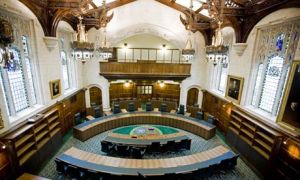
I just came across an interesting Judgement by the Supreme Court of United Kingdom on mergers delivered recently on 16.12.2015 titled Société Coopérative de Production SeaFrance SA v The Competition and Markets Authority and Another, [2015] UKSC 75 (Hat tip to SCC Online) wherein it has been observed that the merger control provisions of the Enterprise Act, 2002 are not limited to the acquisition of a business that is a “going concern” but would include even the acquisition of the assets of a defunct business. According to the Court, An enterprise is subject to merger control if the capacity to perform those activities as part of the same business subsists.”


BACKGROUND TO THE APPEAL

SeaFrance SA, a French company, operated a ferry service between Dover and Calais until it ceased operations on 16 November 2011. It was formally liquidated on 9 January 2012, and most of its employees were dismissed. Groupe Eurotunnel SA (“GET”), the parent company of the Group operating the Channel Tunnel, and Société Coopérative De Production SeaFrance SA (“SCOP”), a workers’ co-operative incorporated by a number of former SeaFrance employees to secure the continuance of the ferry service, acquired substantially all of SeaFrance’s assets on 2 July 2012. This included three of the four SeaFrance vessels, trademarks, IT systems, goodwill and customer lists. GET and SCOP resumed ferry services on 20 August 2012 through GET’s subsidiary company, MyFerryLink SAS. The vessels were operated by employees who had almost all worked for SeaFrance. The reemployment of those employees had been incentivised by a statutory Plan de Sauvegarde de l’Emploi (known as the PSE3), by which SeaFrance’s parent company SNCF would provide payments to employers for employing ex-SeaFrance employees.

The acquisition was referred to the Competition Commission, the regulator at the time. It concluded that there was a “relevant merger situation” for the purpose of the merger control provisions of the Enterprise Act 2002, which could be expected to result in a substantial lessening of competition in the cross-Channel market. The “enterprise” of SeaFrance continued since its “activities” continued, even though there had been a hiatus of over seven months in its operations. The Commission imposed restrictions on the operation of the service by GET and SCOP, including a ban on using the exSeaFrance vessels for ferry services from Dover for 10 years. On appeal to the Competition Appeal Tribunal, the Tribunal gave guidance on the meaning of “enterprise” in the Eurotunnel I judgment, and remitted the question of jurisdiction back to the new regulator, the Competition and Markets Authority.

Upon the remission, the Competition and Markets Authority (which had assumed the functions of the Commission) considered that what had been acquired was an “enterprise”, and therefore that a “relevant merger situation” existed. Accordingly they confirmed the restrictions previously imposed by the Commission. That decision was upheld by the Competition Appeal Tribunal in the Eurotunnel II judgment.

The Court of Appeal allowed an appeal by a majority, holding that GET and SCOP had not acquired an “enterprise”, but only the means of constructing a new (but similar) one. In particular, this was because they had not acquired SeaFrance’s crews. They concluded that it was irrational for the Competition and Markets Authority to reach any other conclusion on the facts.


REASONS FOR THE JUDGMENT

The merger control provisions of the Enterprise Act 2002 are not limited to the acquisition of a business that is a “going concern”. The possession of “activities” is a descriptive characteristic of an enterprise under the Act. An enterprise is subject to merger control if the capacity to perform those activities as part of the same business subsists. [32-35]

The test is one of economic continuity. An Acquirer acquiring assets acquires an “enterprise” where (i) those assets give the Acquirer more than might have otherwise been acquired by going into the market and buying factors of production and (ii) the extra is attributable to the fact that the assets were previously employed in combination in the “activities” of the target enterprise. The period of time between cessation of trading and acquisition of control of the assets may be a relevant factor, but is not necessarily decisive. [36-40]

This was substantially the same principle set out by the Competition Appeal Tribunal in Eurotunnel I, which the Competition and Markets Authority applied in this case. [40-41]

The Court of Appeal’s finding that the Authority’s evaluation was irrational was unjustified. GET and SCOP acquired substantially all the assets of SeaFrance, including trademarks, goodwill, specialist vessels maintained in a serviceable condition, and substantially the same personnel. The Authority’s conclusion that this demonstrated “considerable continuity and momentum” and “the embers of an enterprise”, which could be passed to GET and SCOP, was unimpeachable. The order of the French Court of 9 January 2012 to dismiss the employees did not disrupt that continuity and momentum because the order was made on terms that the PS3 preserved the prospect of employment on the ships for the dismissed crew members. [41-43]

The majority of the Court of Appeal was wrong to narrow the question of economic continuity to the legal effect of the decision of the French Court in January 2012 and whether this terminated the employment relationship between SeaFrance and its employees. The Competition and Markets Authority is not entitled to any special level of deference: the test for determining whether there is a “relevant merger situation” and relevant “activities” is a legal question. [31] But the Authority undertook a broader economic analysis, concluding that there was economic continuity. That evaluation was complex and sensitive to a whole range of factors. It was not a purely legal enquiry. Its economic analysis should be respected. [44-45]

References in square brackets are to paragraphs in the judgment


When one goes through Section 5 of our own Competition Act, 2002 as well as the definition of the term “Enterprise” under Section 2(h) of the Act, there appears scope for a similar dispute to arise in our own jurisdiction in the future. The definition of the term “Enterprise” under Section 2(h) also does not contemplate any such merger or acquisition of a defunct organisation. Yet, this happens on a frequent basis in the Indian corporate sector, albeit since individual transactions are on scales relatively small, they avoid triggering the C.C.I. combination process.

T.R.A.I. Consultation Paper on Differential Pricing for Data Services (A.K.A.) What Has Now Become The Fight Over “Free Basics”. (Part – I)

5629f14533909-logo


At the very outset, it must be stated that the Supreme Court Winter vacations have a tendency to induce one into a hibernating lethargy (in my case, lying tucked in bed with two blankets, a book and a halogen heater), which is the reason this post has taken such a long time to finally come to an end and be published. (For those who may not have understood by now, I am a true summer fan and sincerely dislike winter !!)

While this delay has allowed me to observe and note the developments in the past few days which have taken place regarding the issue, i.e., the “Free basics” fight which has broken out between Facebook and internet freedom activists, it has also at the same time forced me to expand this post to include a discussion on “Free Basics” as a service and whether it can actually help the citizens of India or not.

Coming first to the T.R.A.I. Consultation Paper on Differential Pricing for Data Services, the first question which immediately springs to mind is:- WHY ?? This issue was specifically raised and discussed in the previous T.R.A.I. Consultation Paper On Regulatory Framework for Over-the-Top (O.T.T.) Services (see page 98 onwards, specifically pages 106 – 107) wherein the agreement between Facebook and Reliance (earlier known as “Internet.org” and now reincarnated as “Free Basics”) was specifically discussed and comments on such pacts were called for (Question 13 in the earlier Consultation Paper). Therefore, it makes little sense to release another brand new Consultation Paper to exclusively once again discuss an issue, the responses to which are going to be obvious and the same as they were before. Surprisingly, there is absolutely no mention in the Differential Pricing Consultation Paper about the previous O.T.T. Consultation Paper, which again makes no sense considering the similarity of the issue.

Taking the liberty to speculate, there can only be two reasons for this move by T.R.A.I. One, the T.R.A.I. is in a genuine quandary on “Zero Rating” and is hoping for clarity on whether to allow such services, and this might also explain why it has failed to release its recommendations on the O.T.T. Consultation Paper till date. OR two, it has already taken a decision to allow Zero Rating plans by treating them out of the umbrella of network neutrality but which will be subject to regulation by it and the purpose of the present Paper is only to develop a working regulatory model on consensus.

However, whether one likes it or not, a new separate Consultation Paper on Differential Pricing for Data Services does now exist, and therefore warrants a look, even for those who oppose it.:-

  1. On reading, one can notice that this Consultation Paper focuses more from a perspective of regulation of tariffs. The first three paragraphs of the paper are a clear indication of the direction which T.R.A.I. wants the debate to take,i.e. the debate is being steered away from the one on network neutrality to that of viability of tariff regulation.:

“1. The Telecom Regulatory Authority of India Act, 1997 empowers the Authority to notify tariff for various Telecommunication Services. In exercise of this power, Telecommunication Tariff Order, 1999 (TTO, 1999) was notified for the first time on 9th March, 1999. Amendments in the TTO, 1999 were issued from time to time to reflect the changes in tariff framework. Initially, the tariffs were regulated. However, as the market matured and competition increased, TRAI gradually moved towards a ‘forbearance’ regime and forborne the tariffs for the wireless and the wire line segment in 2002 and 2003 respectively. Currently, except for the national roaming, rural telephony and leased lines, the tariffs for other telecommunication service are under forbearance. As per the policy of ‘light-touch’ regulation being followed, the tariff framework provides the Telecom Service Providers, which include Internet Service Providers and Data Service Providers (hereinafter referred to as TSPs) the freedom to design the tariffs according to the prevailing market conditions.

2. While the tariff regime has been left to forbearance, regulatory oversight is required so that the tariff framework follows the broad regulatory principles elaborated hereafter. Thus, TRAI needs to regularly watch and review the tariffs prevalent in the market. TTO provides for filing of tariffs by TSPs within seven working days of launch. The tariff filing provision plays a critical role in enabling TRAI to scan the prevalent tariff landscape and effectively intervene, wherever required to ensure that the tariff offers are reasonable, transparent, non-discriminatory and are not anti-competitive.

3. The TSPs have the flexibility to decide various tariff components for different service areas of their operation subject to the reporting requirement and other regulatory guidelines in vogue. Tariffs are offered by the TSPs taking into account several factors including input costs, level of competition, commercial considerations 2 and individual business case for each service provider. Even though tariff forbearance and flexibility to the TSPs to determine the rates are core principles of tariff framework, several regulatory guidelines have been prescribed to ensure orderly growth of the telecom sector and protection of consumer interest. Prevention of discriminatory tariff offers and ensuring transparency in tariff offers are amongst the most important principles which the Authority has consistently endeavored to uphold.”

2. Paragraph nineteen provides a fair and reasonable solution to the problem of differential pricing which should be acceptable to clans both for and against “zero rating”. It suggests de-linking free internet access from specific content, and instead limiting it by volume or time. This is a viable solution to the debate and should be eagerly pursued by T.R.A.I. in order to prevent future disputes and litigation on the issue. (The Airtel offer of fifty percent internet “cashback” if used after midnight is an example of such a scheme.)

3. The Paper obviously focuses on mobile data services, which brings us to the larger issue which even western jurisdictions, particularly the E.U., have had to pay extra attention to with regard to mobile network neutrality. (The link is an excellent paper by Christopher Marsden on the issue published in the European Journal of Law and Technology). In India, this assumes further significance since the trend in internet penetration is now confirmed to progress in the hinterland through mobile connectivity. A more detailed discussion will follow during our analysis of “Free Basics”.


In the next post, I will focus on “Free Basics” and discuss the merits and demerits of the scheme being actively promoted by Facebook.