
The Big Bang Tech.


71Afo54hfeL._SL1500_

Things in the media have become typically quiet after the initial flurry of headlines, and as usual, I was supposed to write a lengthy blog post on the antitrust actions against Big Tech , and as usual, it kept getting delayed to the extent that it has now become an exercise in futility. (Man I need to get more disciplined with my writing !! )

So to just bring this to the closure in my own head more than anything else, here is a list of the major and most informative headlines (in no particular order of importance) on the issue:

Silicon Valley pressured as Washington turns up antitrust heat

Unheard for years, smaller fished finally get a say against tech sharks.

On priority: Regulating online giants for financial viability of news business

Senator Warren urges antitrust chief to recuse himself from Google, Apple probes

Four reasons why antitrust actions will likely fail to break up Big Tech

Regulating or breaking up Big Tech: an antitrust explainer

A liberal competition law in the works to facilitate M&As

n2h7o915s42otnqscgro_400x400


The Economic Times recently ran a story on how a liberal competition law regime was in the works and was part of the plan of action for the first hundred days after the formation of the new government.

The proposals seem majorly focused on speeding up IBC resolutions, which isn’t bad, but one does wish that the Corporate Affairs Ministry would also seriously look into the fixing the many flaws in the Competition Act, 2002, in Order to prevent unnecessary litigation on non-competition law issues which have off late become synonymous with Indian Competition Law jurisprudence.

For starters, it would be great if the new government could once again revive the Competition Amendment Bill, which unfortunately lapsed more than half a decade back. We have previously written about it here and here. It wasn’t perfect, but it would have gone a long way in plugging some of the gaps.


Information Manipulation: An Important Side Note of Network Neutrality

attention_manipulation


Freedom of Speech and prevention of a “walled garden” have been one of the prime arguments for network neutrality since the inception of the contest. Expanding on this argument, a side note to also be taken into consideration is the information manipulation which has come to be highlighted since the election of Donald Trump, where the particulars of the information “allowed” to be brought in front of you “help” you to make “your” decision accordingly.

Facebook can be an excellent example to help understand this argument for two reasons. Firstly, it came up with the extremely controversial (but still operational in some countries) FREE BASICS programme. Secondly, it is without a doubt one of the, if not THE most accessible websites on the internet (Google may be the only serious rival, but since Google in my opinion can today be considered a full fledged platform integrated over multiple websites as well as the Android OS rather than just the regular Google website, we’ll stay out of this debate for now and keep it simple.)

Facebook has of course been facing flak in the U.S. over its alleged contribution to last years presidential election, but what it actually more of a worry is the abuse of it’s service in communities outside the U.S., particularly Asia. We’ve partially discussed such issues before on this Blog (see here and here), but the latest example is that of Myanmar, where the rise of Anti-Rohingya sentiment seems to have coincided with a huge boom in the use of social media, a large chunk of which is attributable to Facebook itself. Why ?? Because in 2016, Facebook partnered with MPT, the State run telecom company, to give users access to its Free Basics Programme.

This is not to insinuate that Facebook is directly attempting to control the world and actively working with state regimes to incite hatred against minorities and in all fairness, the issue is excruciatingly complicated, but since Facebook dominates the Social Media space (along with Instagram and WhatsApp), the potential for abuse of its Free Basics programme becomes all the more potent. To quote from a recent article:

“Facebook is not directly responsible for violent conflict, of course, and viral
misinformation is hardly unique to its services. Before social media, there were email hoaxes and urban legends passed from person to person. But the speed of
Facebook’s growth in the developing world has made it an especially potent force
among first-time internet users, who may not be appropriately skeptical of what they see online.”


Delhi High Court Slaps Cost of Rs 1 Lakh. Writ against Section 26(1) CCI Order.

case dismissedIn a rather interesting/unforeseeable turn of events, the Ld. single judge of the Hon’ble Delhi High Court (‘DHC’) has come down heavily on a Petitioner seeking relief against a Section 26(1) Order passed by the Competition Commission of India (‘CCI’).

The writ was filed against order  passed by the CCI under Section 26(1) under Section 26(1) of the Competition Act, 2002 (‘the Act’), whereby the CCI had directed the Director General (‘DG’) to conduct an investigation on an allegation that the petitioner along with certain other manufacturers had contravened the provisions of Section 3(3)(a) and Section 3 (3)(d) of the Act.

The petitioner’s case was solely based on the contention that the said 26(1) order did not make any specific allegation against the petitioner.

A noteworthy background on this particular Sec 26(1) matter; is that the same petitioners had earlier moved to the writ court praying for relief of inspection of files of the CCI pertaining to the said order. And the same relief was granted by the DHC.

Now coming back to exactly what irked the Ld. Single Judge into imposing such heavy costs on the petitioner. Allegedly the whole controversy circles around an apparent untrue statement submitted before the court by the petitioners on their knowledge of  the DG investigation in this particular case.

During the course of arguments , the counsel on behalf on the CCI, submitted before the court, certain documents relating to DG’s questionnaire, which was apparently sent to the Petitioners back in the year 2015, and the petitioners had duly participated in the investigation by replying to the said questionnaire. Without going into any finer details I will just say that this very movement was a true table turner. Because at this juncture the Ld. Single Judge went on to the extent of noting that the false statement and false affidavit of the petitioner make for a fit case to invite proceedings under section 340 of the Cr.P.C.

While not interfering with the operations of the said CCI order, and refusing to stay the  DG investigation, the court  while placing reliance on the Supreme Court case of Competition Commission of India v Steel Authority of India: (2010) 10 744; observed that that an order under Section 26(1) of the Act is in the nature of an administrative order and does not affect the rights of the parties. The Supreme Court had also examined the scheme of the Act and held that the legislative intent was not to permit any appeal against the order passed under Section 26(1) of the Act. Thus, an order under Section 26(1) of the Act cannot be interfered with unless it is established to be perverse or suffering from jurisdictional errors.

And accordingly the said petition was dismissed with with cost quantified at Rs.1,00,000/-. What will now remain interesting to see is how this order impacts the practice being followed by the Opposite parties of  challenging the CCI’s order before the writ court under Article 226 of the Constitution. Would the attitude of not staying the operation of a 26(1) order finally mean that at last the Competition regulator will  have proper time and opportunity of investigating into various alleged contraventions. OR maybe instead of an Article 226 remedy, a review/recall application  before the CCI would be the appropriate way out for the Opposite Parties (Ah! btw hopefully an elaborate post discussing some thoughts on the CCI’s power of Review/Recall- soon). And maybe these investigations see the light of the day and aren’t just left hanging in the middle struggling for a decisive fate for years and years.  And maybe just maybe this would be another step into the direction of having a stronger competition law regime in India.


Fast Track Call Cab Pvt. Ltd. and Anr. v. ANI Technologies Pvt. Ltd., Case No. 6 and 74 of 2015

uber-ola

download

There are certain cases in any area of jurisprudence in law, including competition law, which tend to make an individual mark of their own. This may be simply due to the parties involved, or because the cases involve seminal questions in law which would help clarify the legislation involved for future use, or because the ramifications (not necessarily negative) of the Final Order go beyond just the law involved, and into the arena of a change in the very economics or social structure of the system the case may question.

In my personal opinion, Fast Track Call Cab Pvt. Ltd. and Anr. v. ANI Technologies Pvt. Ltd., Case No. 6 and 74 of 2015 falls into this category and for all the reasons stated above.

My criticism of past Orders of the Commission through this Blog is well known, but this time, I must bring on record my appreciation. The Final Order is by no means perfect or maybe even completely legally sound in all aspects, but it does display not only the growing maturity of competition jurisprudence by the Commission, but also at least an attempt by the D.G. to not be content with a superficial investigation of  relevant market dynamics.

Both Ola and Uber have already suffered enough regulatory troubles regards surge pricing and driver registration from various transport departments across the country, and though Ola has won this round, there will most probably be an Appeal. But the biggest fallout for Ola (and even Uber), which in my personal opinions has made it a pyrrhic victory, is that the D.G. and the Commission have extensively written about the below cost pricing strategies adopted by both companies. In fact, the D.G. has gone so far as to note that the significant market share of Ola or Uber has nothing to do with technological innovation but is rather the pure consequent of below cost pricing. Whether the companies like it or not, it is probable that both Ola and Uber will be prodded to bring down the revenue drain, not just by investors but also by competitors and various state departments as economically, a market providing services below cost can under no circumstances be considered an economically sound market, and creates potential avenues for future investigations by the Commission.

COLLECTIVE DOMINANCE BACK IN THE LIMELIGHT

An alternative argument which was raised by the Informants while objecting to the D.G. Report was that there is a possibility of two entities exercising dominance at the same time. The Informants claimed that the analysis of the D.G. pointed towards the presence of more than one dominant player in the relevant market. Furthermore, they submitted that the D.G. in its report had admitted the growth of both Ola and Uber was not the result of any technological innovation or efficiency but the result of a practice to charge substantially below the average variable cost. The Informants also quoted the observations of the Canadian Competition Tribunal in the Visa Mastercard Case, which noted that both MasterCard and Visa can individually possess market power in the relevant market. It was thus submitted that a conclusion of simultaneous dominance of Ola and Uber was not incompatible with the provisions of the Competition Act, 2002.

I have already on a number of occasions discussed Collective Dominance (See here, here and here) and how it is not presently recognised under the Act. The Commission’s reasoning is similar to what we have already propagated here and I have nothing new to add in this area.

However, for the fun of it, let us hypothetically presume that Collective Dominance was recognised under the Competition Act. Could Ola and Uber have been held liable for abuse of dominant conduct ?? I would submit the answer would still be a no. 

Firstly, since the Uber investigation has been stayed by the Supreme Court, no finding or penalty could be imposed upon Uber. But beyond that, secondly and more importantly, is that Ola and Uber would never be able to breach the threshold for Collective Dominance under Competition Law, and to  understand why one needs to look into the case of U.S.A. v. VISA Et al., 344 F.3d 229 (United States Court of Appeals, second Circuit.). Similar issues were raised against VISA and Mastercard. To summarise, the United States Department of Justice brought enforcement action against the two payment card networks and licensor of one payment card brand, alleging that governance duality between networks and networks’ exclusivity rules were agreements in restraint of trade in violation of Sherman Antitrust Act. Challenging the organizational structure of two of the nation’s four major payment card systems, the complaint charged that MasterCard and Visa U.S.A., which are organized as joint ventures owned by their member banking institutions,conspired to restrain trade in two ways: (1) By enacting rules permitting a member-owner of one to function as a director of the other (an arrangement the government described as “dual governance”) (Count I); and (2) by enacting and enforcing “exclusionary rules,” which prohibit their member banks from issuing American Express (“Amex”) or Discover cards (Count II).

The Court held that Visa U.S.A. and MasterCard violated the Sherman Antitrust Act by enforcing their respective versions of the exclusionary rule, barring their member banks from issuing Amex or Discover cards. The Court further held that Visa International, which owns the Visa brand, licenses it to Visa U.S.A., and exercises certain governance powers over Visa U.S.A., was liable for participating in Visa U.S.A.’s violation. Factually, it is important to note that a member of either the Visa U.S.A. or MasterCard network could also be a member of the other network. Thus a bank that was a member of Visa U.S.A.’s network and issued Visa cards could also be a member of the MasterCard network and issue MasterCard cards. On the other hand, both MasterCard and Visa U.S.A. had promulgated rules that prohibited their members from issuing American Express or Discover cards. Evidence was also cited that atleast three major U.S. issuer banks would have contracted with American Express to issue Amex cards in the United States but for the exclusionary rules.

In other words, in Visa Mastercard, there was active collusion between the two entities to limit market access to the other two competitors, whereas in the case of Ola and Uber, it is anything but !! Both companies are constantly at each other’s throats on pricing and volume of rides in the country. We are starting to see a cut back on the below cost pricing strategy, but only a continual market watch on the sector will help to gather enough data to understand the consequent effects, and it is too early to take a firm decision as of today. Since Ola and Uber have together effectively turned the market as  one heavily based on network effects,  strong competition and constant change in market share might be the norm between the two for some time to come.

POST SCRIPT: UBER IN INDIA 

The Uber legal team would have been on their tenterhooks till this Order came out, and will be studying it closely (the investigation against Uber has been stayed due to questions of law regarding the powers of the erstwhile Competition Appellate Tribunal (COMPAT) and the matter is presently pending in the Supreme Court). The relevant market would obviously include Uber, and the D.G./Commission made a number of observations regarding the company, such as:

1. “…[i]n the first six months of 2015-16 (till September 2015), the D.G. noticed that while OP’s market share increased from marginally by 2% to 3%, Uber’s share increased at a faster rate i.e. by about 20%-22%.” [This is definitely due to a lower base rate.]

2. “It was further noted that from March 2015 onwards, Uber has maintained the second position. The D.G. also noted that from January to September 2015, Uber’s trip size registered growth of nearly 1200%, while OP’s growth has been about 63% during the same period.” [Same reason as above.]

3. “The D.G., thus, noted that backed by its marketing technology and logistics and financial support, Uber was able to successfully counter the pricing strategy of OP, and being able to sustain losses, which restrained OP from exercising market power in the relevant market. This was evident from the fact that similar strategy was followed by Uber and as a result, the gap in market share between OP and Uber narrowed down from 69% in January 2015 to 22% by September 2015.”

4.  “Further, with the steady increase in Uber’s market share from 6 – 7% in January 2015 to 36-37% in September 2015, it could not be said whether OP would be in a position to hold on to its market share for a sustainable period for assessment of dominance in the relevant market.”

5. “Thus, D.G. opined that both OP and Uber have adopted ‘below-cost pricing strategy’. However, since the scheme of the Act only attracts the provisions of Section 4 when an incumbent is found to be dominant, the D.G. stated that OP can be said to have
indulged in abuse by way of predatory pricing, only if it is found to be dominant in the relevant market. Since OP was not found to be dominant, the D.G. concluded that OP did not contravene the provisions of Section 4 of the Act.” [Emphasis added]

6.  “On the other hand, Uber, which entered the relevant market in 2013-14, expanded its network rapidly to account for nearly one third of the active fleet in the relevant market in 2015-16. In terms of annual number of trips, its share increased from 1 – 2% in 2013-14 to 30-31% in 2015-16.” 

7. “…[U]ber, entered the relevant market in the year 2013 and garnered a sizeable market share in just about two years’ time. In terms of number of trips on monthly basis, its share increased from 0-1% in August 2013 to 36-37% in September 2015. Further, Uber showed a steady growth February 2015 onwards, with its share in terms of monthly number of trips having increased from 6-7 % in January 2015 to 36-37% by September 2015. Its entry as well as steady growth during the period of investigation shows that the market was evolving. While Uber’s entry, as the Informant has argued, did not dislodge OP during the period of investigation, OP’s declining market share post January 2015 reflects the competitive constraint posed by Uber and the fragility of leadership position in a dynamic business environment, as discussed earlier.” 

8. “As a matter of record, in the present case, OP does not have an edge over all its competitors in terms of the size and resources. Interestingly, the investigation revealed that that Uber Inc., which is the parent company for Uber had a total capital investment of about 15 to 20 times of OP’s financial resources.” [The C.C.I. doesn’t seem to have made much of this, but it is important to note that “size and resources of the enterprise” and “economic power of the enterprise including commercial advantages over competitors” are two of the factors to be taken into consideration during an inquiry under Section 19(4)(b) and Section 19(4)(d) of the Act respectively.]

All this goes to show that Ola may owe Uber one for its victory, and also that Uber will be fully focused to ensure a favourable outcome in the Supreme Court to avoid the cross hairs of the D.G./C.C.I.


Network Neutrality: An Update

loading


Yesterday (30.08.2017) will be marked as a watershed day by observers for Network Neutrality. The issue is being hotly contested in arguably the world’s most capitalistically advanced jurisdiction for telecom and the internet (U.S.A.) as well as the jurisdiction with potentially the biggest telecom and internet market, both by the number of users as well as revenue (India) and yesterday was an eventful day in both.

In India, the Telecom Regulatory Authority of India (T.R.A.I.)  held and concluded an Open House Session in New Delhi on the issue of Network Neutrality. Unfortunately, being bed – ridden with a fracture, I was unable to attend it myself, but I am informed that all parties were “extremely vocal” with their opinions. T.R.A.I. is likely to publish its recommendations by October. On a side note, Certain telecom companies also complained against SIM-locked handsets coupled with a tariff plan and said that a limited access to certain applications through such devices was as good as a “walled – garden” and against Network Neutrality (No prizes for guessing who they’re talking about).

At the opposite end of the globe, yesterday was the last day to file comments on the Federal Communications Commission plan to deregulate broadband service and roll back net neutrality rules, and at least 21.9 million comments have been confirmed to have been received. Voting by the F.C.C. on the issue is not expected anytime soon, as the Commission is known to take it’s time with decisions after such commentary periods.

Here’s to waiting and watching and hoping for the best.

Online Competition and Offline Democracy

41cjYoOdboL._SX327_BO1,204,203,200_

Consumer Choice and Competition Law are devilishly heavy in terms of choice of literature, from the side of law as well as economics, and a collection of all books on the subject together can easily be used to create a specialised two floor (at least) library of its own. (which I would love, if I might add. :-))

The topic being so generic in phrase, it continues to evolve and grow as our own economy and society evolves and grows with every passing year, with the question of choice (and the use of Game Theory) continuously intriguing at every level of society and economy.

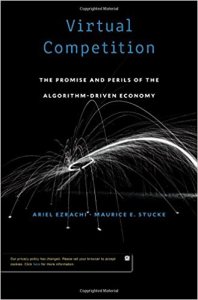
The next level of evolution of human society, after the invention of the modern internet (world wide web), has been its swift amoebic growth into the very fabric of our daily lives, and it is the consequence of this growth from a competition law perspective that Ariel Ezrachi and Maurice Stucke claim they look into and answer through their book Virtual Competition. They even go so far as to say in a blog post (and they may quite well be right) that the intertwining of A.I. and the internet into our daily lives has the ability to completely alter our thought process, including politically, and turn the definition of “Democracy” totally upside down.

Obviously, a self – confessed internet economy growth buff like me is more than eager to read the book (It’s available on Amazon India and not even very expensive, though the delivery charge sucks.) The Wall Street Journal already published a book review on it. And once I finish it, we should have one here as well. 🙂


Book Review: The Master Switch by Tim Wu.

The-Master-Switch


(This is actually an old article which was originally published on the India Law and Technology Blog, where once upon a time I was a regular guest blogger. Unfortunately, sometime back all of them got wiped out. I often get messages about those posts, but sadly many of them were typed directly on the wordpress platform. Hence, no copy and as a consequence, permanently lost. Fortunately, while rummaging for something else, I chanced upon one of my earlier posts from the days when I still preferred to type a word draft first.)

At the very outset, I must confess, I have never been an absolute supporter of network neutrality and still am not. Another writer on this Blog has written before that he feels that the internet is inherently discriminatory, and I am inclined to agree with him. The writer of that post has summarized the reasons why the subject has become such a debatable issue among the learned, yet one can find that the subject has failed to convincingly grip the imagination and attention of the general pubic. And the various research papers and articles written and published in various journals of repute by the proponents of network neutrality are in the writers personal opinion, often too complex and long to enlighten and help an average reader to engage in an active debate on the topic. (After all, few individuals, except for law students or lawyers, will take the pains to read a seventy seven page article in the Harvard Journal of Law and Technology!!)

Notwithstanding what has been written above, THE MASTER SWITCH by Tim Wu is a welcome change to such articles. It is everything that should be asked of a book on a policy issue: Concise, simple, interesting so as to be able to grasp the attention of the reader, and most importantly, synchronized with itself, i.e., all the chapters within it. It also helps to better justify his stand as a proponent of network neutrality by using the “destruction of innovation” argument, which he failed to adequately explain in his papers and which has often been made into the weak link in the armour to be exploited by the those not in favour of network neutrality.

To summarise, he has used the Schumpetarian cycle of “destructive creation” to try and justify why there is a need to enact a Network Neutrality Legislation. He shows through historical examples how each new innovative medium of communication, from the Telegraph to the Television, has over time, though born as an innovative new and “free” medium to communicate, has slowly been centralized and been absorbed to be manipulated and controlled by the few large corporations who have eventually come to dominate the American industry and even Government policy. He then talks about how the Internet is a medium far more revolutionary then any of its communication predecessors and hence, any centralization of this medium shall, in fact result, in an unacceptable loss of freedom of expression.

After reading the book, one begins to understand that the reason a Network Neutrality Legislation needs to be enacted is not with the de jure intention of necessarily keeping the internet neutral, but with the de facto intention of actually controlling corporations from gaining too much control over the medium. A question which arises at this point is “why do we need a specific legislation? Why is the FTC (or, in India’s case, the CCI) not enough to control such an abuse of dominance, should it ever arise?” Wu answers this question, by again, citing historical examples on how these corporations have, through their clout, managed to subvert or walk around such Anti – Trust procedures through effective and efficient lobbying in the U.S. Congress. Despite its lack of effectiveness though, it is interesting to see how Anti – Trust law can act as an effective tool to against network discrimination.

If a complaint has to be raised against the book, it would be that for some reason it lacks any mention whatsoever of Facebook, which is quite surprising considering the status and clout which the site has achieved to influence individual opinion in our times. However, after reading, I must confess, I am far more convinced for the need for specific legislation on network neutrality than I was before.

As a post script, for all those interested in understanding the issue of network neutrality in simple language devoid of most technicalities, I recommend the following essay by Edward W. Felten:

http://dreadedmonkeygod.net/home/attachments/neutrality.pdf