
Please click here to see an update on the previous post.
2nd International Competition Law Conference 2012
The Competition Law Bar Association is organising the 2nd International Competition Law Conference 2012 on 28th April, 2012.
The venue for the event is the Shangri – La’s Eros Hotel, new Delhi, India
The details of the conference can be found here.
National Level Essay Competition, 2012.
The CCI is once again organizing an Essay Competition on Competition Law. The last date for submission of entries is 30th June, 2012.
Further details regarding the competition can be found here.
Why the Communications Sector Should not be Exempted From the Competition Act.

Communications Today reported on 19th March, 2012 that the Telecom Department will ask the Union Cabinet to exempt the communications sector from the country’s Competition Act. According to the article, “the move comes after the competition watchdog-Competition Commission of India (CCI)-recently raised the red flag over the telecom ministry’s plans to allow mergers and acquisitions (M&As) if the combined market share of merged mobile phone companies was less than 60 percent.”
We shall not comment upon the logic or exigencies which compel the Telecom Department to make such a demand but shall only list below point by point reasons the reason why we feel the Telecommunications sector should not be exempted under the Competition Act, irrespective of the complaints which support the request. They are as follows:
1. As of December, 2011. there were exactly fifteen different players in the Sector (Bharti Airtel, Reliance Comm., Vodafone India, Idea Cellular, BSNL, Tata Teleservices, Aircel, Uninor, Sistema Shyam Teleservices, Videocon Tele, MTNL, S Tel, Loop Telecom, Etisalat DB, HFCL). Granted, there are maybe players one too many in the sector, but the fact remains that six of the above are extremely small players, with atleast two of them confirmed to be losing subscribers as per TRAI. Only the first eight are predicted by analysts to be major market players in the sector, and it is expected that these players shall in all probability fade away on their own. This is exactly what is envisaged in a competitive sector. The players in the relevant market which fail to grow and develop themselves in the relevant market should leave.
2. Continuing from the above, talking from the consumers perspective, tariff rates in the telecom sector in India can hardly be considered as an issue as frankly, they are one of the lowest in the world and even if assuming that they are raised in the near future, users can well afford the market rates, despite the recent cease fire in price wars. Admittedly, quality of service is a problem, but the reason for that is primarily lack of infrastructure rather than excess of competition, and merging companies shall certainly not help improve the same. What is required is some seriously heavy investment in infrastructure, rather than simply buying out smaller players in the market, and additionally maybe even some corporate restructuring.
3. The Supreme Court has recently cancelled all 2G licenses issued during A. Raja’s tenure as Minister of Telecommunications. With the Judgement it self being questionable as regards its ratio and till a certain extent, its reasoning, and at the same time a Presidential reference also having been filed asking for clarifications to the same, it is best to follow a wait and watch policy and act only after receiving the Supreme Court’s reply on the Reference.
4. As per the Economic Times, there is a new round of Spectrum wars that’s about to begin with the upcoming re-auctioning of spectrum. Again, it is best to wait till the conclusion of the auction before deciding on such issues.
5. Clause 5(3) of the The Competition Commission of India (Procedure in regard to the transaction of business relating to combinations) Regulations, 2011 provides that form may be filed preferably where “the parties to the combination are engaged in production, supply, distribution, storage, sale or trade of similar or identical or substitutable goods or provision of similar or identical or substitutable services and the combined market share of the parties to the combination after such combination is more than fifteen percent (15%) in the relevant market”. In light of this sub-clause, it is best to maintain harmony between various government policies and the Act and regulations made under it in order to prevent unnecessary conflicts and confusion between the CCI, the Government and the Industry. In fact, the government, in its National Competition Policy, has sought to bring about harmony between the Act and policies and has suggested an elaborate mechanism to achieve the same.
6. Finally, if such an exemption is allowed, it will set a bad precedent in general and may encourage industries to lobby for exemptions in their favour.
The source of all data and statistics is The Economic Times
India Finally Starts to Open its Eyes !! :)
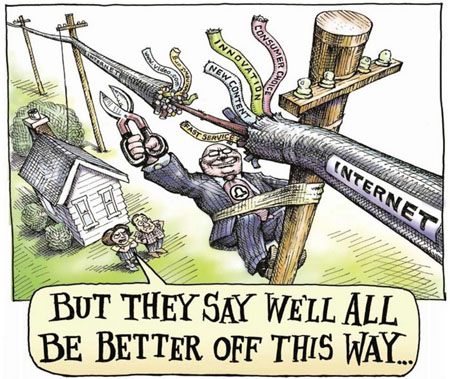
India has finally started opening its eyes towards the principle of Network Neutrality and its potential violation !! The Economic Times yesterday carried an excellent article on the subject. We strictly feel its about time the issue started gaining prominence in our Country !!
For previous posts o network neutrality on this Blog, see here, here and here.
Press Statement by the Ministry of Corporate Affairs

The ministry of Corporate Affairs, Government of India, released a press statement yesterday stating that “the Competition Commission of India has started facilitating competition assessment of rules, regulations and government policies, contents of which may inadvertently impact the competitive atmosphere adversely.” It also stated that the process was for “evaluating government policies, regulations, rules and laws for identification of those which unnecessarily impede competition and suggest measures to redesign the identified ones so that competition is not unduly inhibited.”
The task has been assigned to the CCI with the intention to begin implementation of the National Competition Policy (Apologies. Unfortunately, the latest draft seems to have disappeared off the internet. Will update this post as soon as it is found.)
The press statement can be found here
The Domination of Sport

Two of the complaints presently before the Commission are those filed against Hockey India by several Hockey Olympians as well as a group of chess players who have separately approached the Competition Commission of India (CCI) over the abuse of dominant positions by the respective authorities overlooking their sports in India.
Hockey India, which holds the sole mandate to govern and conduct all activities for hockey in India warned players that if they participated in the World Series Hockey (WSH) proposed by the Indian Hockey Federation, they would lose their position in the national team.
Interestingly, there is little to go by precedent on this specific issue, i.e., whether a sports regulatory body abuses its dominant position by imposing certain restrictive conditions upon the players affiliated to it, and therefore the Commission could end up conducting some pioneering research and analysis in this field. while there have been cases on the legality of exclusivity arrangements in the sports sectors regarding sports equipment and sportswear ( See American needle v. NFL), the closest dispute to the present issue arose in the EU in the withdrawn preliminary reference in the Oulmers Case, which involved issues relating to the right of clubs to be compensated by national federations for the release of their players for international games and tournaments. It was initiated by a complaint lodged by ASOBAL (the Spanish Handball League) before the European Commission in March 2009. The complainant argued that by precluding the payment of a compensation to clubs the regulations governing the release of players restricted competition were contrary to both articles 101 and 102 TFEU. The European Commission took an interest in the case and started a preliminary investigation which was only put to an end pursuant to an agreement between ASOBAL and the European Handball Federation.
It will be interesting to see how the Commission handles this complaint.
Conference on “Competition Law in emerging economies: Trends and Developments in India”

The Jindal Global Law School, Sonipat (JGLS) and the Asian-African Legal Consultative Organisation (AALCO) recently held a two-day conference with a focus on “Competition Law in emerging economies: Trends and Developments in India”. The conference venue was the AALCO office on February 28, 2012 and the JGLS university premises on February 29, 2012 and attended by experts in the field of competition law, lawyers, academics, representatives from law firms and JGLS students
Click here to read a detailed cover of the program.
 Indian Competition and Anti-Trust Blog