A Rechristening. :D

Ladies and gentlemen !!

We are proud to announce that our website url has now officially been changed from “indiancompetitionantitrust.wordpress.com” to “icaab.org”. 🙂

Our ambition has finally got the better of us and there are a lot more changes on the way, including a revamp of the design layout as well as the addition of new pages. Keep an eye out for them here. 😉

Here’s to taking this to the next level.

Cheers !!

Sudipto

Foundation of Media Professionals v. Union Territory of Jammu and Kashmir and Anr., Writ Petition Diary No. 10817 of 2020 : Another Opportunity to press for Right to Internet ?

Supreme-court_20181102_570_850


The Union Territory of Jammu and Kashmir (which before the Supreme Court is almost always represented by a Counsel for the Union of India) a few days ago filed an Affidavit expressly making a statement that the right to access the internet is not a fundamental right. To quote the text verbatim below:

“It is submitted that the right to access the internet is not a fundamental right and thus the type and breadth of access for exercising the right to freedom of speech and expression under Article 19(1)(a) and/or to carry on any trade or business under Article 19(1)(g) of the Constitution of India (CoI) through the medium of internet can be curtailed….”

The submission was made in the specific context of the action of the Union to not allow the speed of the internet to be more than that of a 2G cellular network. But my excitement at this statement is not a rage against any high handedness (which is presently sub-judice before the Court) by the administration but rather the opportunity which once again arises to argue a right to internet access !!

It appears to be a common misconception among the public that the Supreme Court has settled this question once and for all in Anuradha Bhasin v. Union of India and Ors., W. P. (Civil) 1031 of 2019. On the contrary however, it specifically observed that:

“28. None of the counsels have argued for declaring the right to access the internet as a fundamental right and therefore we are not expressing any view on the same. We are confining ourselves to declaring that the right to freedom of speech and expression under Article 19(1)(a), and the right to carry on any trade or business under 19(1)(g), using the medium of internet is constitutionally protected.”

Rather, what it went on to hold was that:

“…the freedom of speech and expression and the freedom to practice any profession or carry on any trade, business or occupation over the medium of internet enjoys constitutional protection under Article 19(1)(a) and Article 19(1)(g). The restriction upon such fundamental rights should be in consonance with the mandate under Article 19 (2) and (6) of the Constitution, inclusive of the test of proportionality.” (Emphasis added)

Yes, I agree that there is scope for a submission that the answer might be the same even if the issue was worded differently to specifically make submissions on the right to access the internet, but that doesn’t degrade the importance of the issue and its affect on policy matters such as Network Neutrality, concerning which passionate arguments from both sides of the fence tend to be based, at their core, on the  right of access to the internet !! (The difference between the two sides is the interpretation of such a right and what is encompassed within it.)

The Court also itself recognised that it the issue could not be simply dismissed as irrelevant and required some serious consideration, if not on that day, then definitely someday later. Certain paragraphs in the first half of the Judgement are encouraging.:

“22. Now, we need to concern ourselves about the freedom of expression over the medium of internet. There is no gainsaying that in today’s world the internet stands as the most utilized and accessible medium for exchange of information. The revolution within the cyberspace has been phenomenal in the past decade, wherein the limitation of storage space and accessibility of print medium has been remedied by the usage of internet.

23. At this point it is important to note the argument of Mr. Vinton G. Cerf, one of the ‘fathers of the internet’. He argued that while the internet is very important, however, it cannot be elevated to   the status of a human right. Technology, in his view, is an
enabler of rights and not a right in and of itself. He distinguishes between placing technology among the exalted category of other human rights, such as the freedom of conscience, equality etc. With great respect to his opinion, the prevalence and extent of internet proliferation cannot be undermined in one’s life.

24. Law and technology seldom mix like oil and water. There is a consistent criticism that the development of technology is not met by equivalent movement in the law. In this context, we need to note that the law should imbibe the technological development
and accordingly mould its rules so as to cater to the needs of society. Non recognition of technology within the sphere of law is only a disservice to the inevitable. In this light, the importance of internet cannot be underestimated, as from morning to night we are encapsulated within the cyberspace and our most basic activities are enabled by the use of internet.

25. We need to distinguish between the internet as a tool and the freedom of expression through the internet. There is no dispute that freedom of speech and expression includes the right to disseminate information to as wide a section of the population as is possible. The wider range of circulation of information or its greater impact cannot restrict the content of the right nor can it justify its denial. [refer to Secretary, Ministry of Information & Broadcasting Government of India v. Cricket Association of Bengal, (1995) 2 SCC 161; Shreya Singhal v. Union of India, (2015) 5 SCC 1].” (Emphasis added)

My only disgruntlement is with the first line of paragraph twenty five which has been quoted above, because I am firmly of the opinion that the internet cannot and should not be classified as a tool, but rather as a resource which is used by individuals and entities to create tools and services for mankind. I’ve focused on this here and here, and am now thinking of doing a separate piece altogether on the justification for such a classification.

Hopes can be belied of course, and with the present Covid – 19 situation in New Delhi, it’s best not to hazard a guess as to when the Court will start functioning on a regular schedule again, and even if it does, whether such full fledged arguments as I hope for will even actually take place. But then, no harm being optimistic. 🙂

A liberal competition law in the works to facilitate M&As

n2h7o915s42otnqscgro_400x400


The Economic Times recently ran a story on how a liberal competition law regime was in the works and was part of the plan of action for the first hundred days after the formation of the new government.

The proposals seem majorly focused on speeding up IBC resolutions, which isn’t bad, but one does wish that the Corporate Affairs Ministry would also seriously look into the fixing the many flaws in the Competition Act, 2002, in Order to prevent unnecessary litigation on non-competition law issues which have off late become synonymous with Indian Competition Law jurisprudence.

For starters, it would be great if the new government could once again revive the Competition Amendment Bill, which unfortunately lapsed more than half a decade back. We have previously written about it here and here. It wasn’t perfect, but it would have gone a long way in plugging some of the gaps.


Information Manipulation: An Important Side Note of Network Neutrality

attention_manipulation


Freedom of Speech and prevention of a “walled garden” have been one of the prime arguments for network neutrality since the inception of the contest. Expanding on this argument, a side note to also be taken into consideration is the information manipulation which has come to be highlighted since the election of Donald Trump, where the particulars of the information “allowed” to be brought in front of you “help” you to make “your” decision accordingly.

Facebook can be an excellent example to help understand this argument for two reasons. Firstly, it came up with the extremely controversial (but still operational in some countries) FREE BASICS programme. Secondly, it is without a doubt one of the, if not THE most accessible websites on the internet (Google may be the only serious rival, but since Google in my opinion can today be considered a full fledged platform integrated over multiple websites as well as the Android OS rather than just the regular Google website, we’ll stay out of this debate for now and keep it simple.)

Facebook has of course been facing flak in the U.S. over its alleged contribution to last years presidential election, but what it actually more of a worry is the abuse of it’s service in communities outside the U.S., particularly Asia. We’ve partially discussed such issues before on this Blog (see here and here), but the latest example is that of Myanmar, where the rise of Anti-Rohingya sentiment seems to have coincided with a huge boom in the use of social media, a large chunk of which is attributable to Facebook itself. Why ?? Because in 2016, Facebook partnered with MPT, the State run telecom company, to give users access to its Free Basics Programme.

This is not to insinuate that Facebook is directly attempting to control the world and actively working with state regimes to incite hatred against minorities and in all fairness, the issue is excruciatingly complicated, but since Facebook dominates the Social Media space (along with Instagram and WhatsApp), the potential for abuse of its Free Basics programme becomes all the more potent. To quote from a recent article:

“Facebook is not directly responsible for violent conflict, of course, and viral
misinformation is hardly unique to its services. Before social media, there were email hoaxes and urban legends passed from person to person. But the speed of
Facebook’s growth in the developing world has made it an especially potent force
among first-time internet users, who may not be appropriately skeptical of what they see online.”


Delhi High Court Slaps Cost of Rs 1 Lakh. Writ against Section 26(1) CCI Order.

case dismissedIn a rather interesting/unforeseeable turn of events, the Ld. single judge of the Hon’ble Delhi High Court (‘DHC’) has come down heavily on a Petitioner seeking relief against a Section 26(1) Order passed by the Competition Commission of India (‘CCI’).

The writ was filed against order  passed by the CCI under Section 26(1) under Section 26(1) of the Competition Act, 2002 (‘the Act’), whereby the CCI had directed the Director General (‘DG’) to conduct an investigation on an allegation that the petitioner along with certain other manufacturers had contravened the provisions of Section 3(3)(a) and Section 3 (3)(d) of the Act.

The petitioner’s case was solely based on the contention that the said 26(1) order did not make any specific allegation against the petitioner.

A noteworthy background on this particular Sec 26(1) matter; is that the same petitioners had earlier moved to the writ court praying for relief of inspection of files of the CCI pertaining to the said order. And the same relief was granted by the DHC.

Now coming back to exactly what irked the Ld. Single Judge into imposing such heavy costs on the petitioner. Allegedly the whole controversy circles around an apparent untrue statement submitted before the court by the petitioners on their knowledge of  the DG investigation in this particular case.

During the course of arguments , the counsel on behalf on the CCI, submitted before the court, certain documents relating to DG’s questionnaire, which was apparently sent to the Petitioners back in the year 2015, and the petitioners had duly participated in the investigation by replying to the said questionnaire. Without going into any finer details I will just say that this very movement was a true table turner. Because at this juncture the Ld. Single Judge went on to the extent of noting that the false statement and false affidavit of the petitioner make for a fit case to invite proceedings under section 340 of the Cr.P.C.

While not interfering with the operations of the said CCI order, and refusing to stay the  DG investigation, the court  while placing reliance on the Supreme Court case of Competition Commission of India v Steel Authority of India: (2010) 10 744; observed that that an order under Section 26(1) of the Act is in the nature of an administrative order and does not affect the rights of the parties. The Supreme Court had also examined the scheme of the Act and held that the legislative intent was not to permit any appeal against the order passed under Section 26(1) of the Act. Thus, an order under Section 26(1) of the Act cannot be interfered with unless it is established to be perverse or suffering from jurisdictional errors.

And accordingly the said petition was dismissed with with cost quantified at Rs.1,00,000/-. What will now remain interesting to see is how this order impacts the practice being followed by the Opposite parties of  challenging the CCI’s order before the writ court under Article 226 of the Constitution. Would the attitude of not staying the operation of a 26(1) order finally mean that at last the Competition regulator will  have proper time and opportunity of investigating into various alleged contraventions. OR maybe instead of an Article 226 remedy, a review/recall application  before the CCI would be the appropriate way out for the Opposite Parties (Ah! btw hopefully an elaborate post discussing some thoughts on the CCI’s power of Review/Recall- soon). And maybe these investigations see the light of the day and aren’t just left hanging in the middle struggling for a decisive fate for years and years.  And maybe just maybe this would be another step into the direction of having a stronger competition law regime in India.


Online Competition and Offline Democracy

41cjYoOdboL._SX327_BO1,204,203,200_

Consumer Choice and Competition Law are devilishly heavy in terms of choice of literature, from the side of law as well as economics, and a collection of all books on the subject together can easily be used to create a specialised two floor (at least) library of its own. (which I would love, if I might add. :-))

The topic being so generic in phrase, it continues to evolve and grow as our own economy and society evolves and grows with every passing year, with the question of choice (and the use of Game Theory) continuously intriguing at every level of society and economy.

The next level of evolution of human society, after the invention of the modern internet (world wide web), has been its swift amoebic growth into the very fabric of our daily lives, and it is the consequence of this growth from a competition law perspective that Ariel Ezrachi and Maurice Stucke claim they look into and answer through their book Virtual Competition. They even go so far as to say in a blog post (and they may quite well be right) that the intertwining of A.I. and the internet into our daily lives has the ability to completely alter our thought process, including politically, and turn the definition of “Democracy” totally upside down.

Obviously, a self – confessed internet economy growth buff like me is more than eager to read the book (It’s available on Amazon India and not even very expensive, though the delivery charge sucks.) The Wall Street Journal already published a book review on it. And once I finish it, we should have one here as well. 🙂


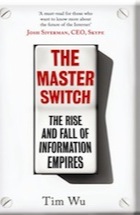
Book Review: The Master Switch by Tim Wu.

The-Master-Switch


(This is actually an old article which was originally published on the India Law and Technology Blog, where once upon a time I was a regular guest blogger. Unfortunately, sometime back all of them got wiped out. I often get messages about those posts, but sadly many of them were typed directly on the wordpress platform. Hence, no copy and as a consequence, permanently lost. Fortunately, while rummaging for something else, I chanced upon one of my earlier posts from the days when I still preferred to type a word draft first.)

At the very outset, I must confess, I have never been an absolute supporter of network neutrality and still am not. Another writer on this Blog has written before that he feels that the internet is inherently discriminatory, and I am inclined to agree with him. The writer of that post has summarized the reasons why the subject has become such a debatable issue among the learned, yet one can find that the subject has failed to convincingly grip the imagination and attention of the general pubic. And the various research papers and articles written and published in various journals of repute by the proponents of network neutrality are in the writers personal opinion, often too complex and long to enlighten and help an average reader to engage in an active debate on the topic. (After all, few individuals, except for law students or lawyers, will take the pains to read a seventy seven page article in the Harvard Journal of Law and Technology!!)

Notwithstanding what has been written above, THE MASTER SWITCH by Tim Wu is a welcome change to such articles. It is everything that should be asked of a book on a policy issue: Concise, simple, interesting so as to be able to grasp the attention of the reader, and most importantly, synchronized with itself, i.e., all the chapters within it. It also helps to better justify his stand as a proponent of network neutrality by using the “destruction of innovation” argument, which he failed to adequately explain in his papers and which has often been made into the weak link in the armour to be exploited by the those not in favour of network neutrality.

To summarise, he has used the Schumpetarian cycle of “destructive creation” to try and justify why there is a need to enact a Network Neutrality Legislation. He shows through historical examples how each new innovative medium of communication, from the Telegraph to the Television, has over time, though born as an innovative new and “free” medium to communicate, has slowly been centralized and been absorbed to be manipulated and controlled by the few large corporations who have eventually come to dominate the American industry and even Government policy. He then talks about how the Internet is a medium far more revolutionary then any of its communication predecessors and hence, any centralization of this medium shall, in fact result, in an unacceptable loss of freedom of expression.

After reading the book, one begins to understand that the reason a Network Neutrality Legislation needs to be enacted is not with the de jure intention of necessarily keeping the internet neutral, but with the de facto intention of actually controlling corporations from gaining too much control over the medium. A question which arises at this point is “why do we need a specific legislation? Why is the FTC (or, in India’s case, the CCI) not enough to control such an abuse of dominance, should it ever arise?” Wu answers this question, by again, citing historical examples on how these corporations have, through their clout, managed to subvert or walk around such Anti – Trust procedures through effective and efficient lobbying in the U.S. Congress. Despite its lack of effectiveness though, it is interesting to see how Anti – Trust law can act as an effective tool to against network discrimination.

If a complaint has to be raised against the book, it would be that for some reason it lacks any mention whatsoever of Facebook, which is quite surprising considering the status and clout which the site has achieved to influence individual opinion in our times. However, after reading, I must confess, I am far more convinced for the need for specific legislation on network neutrality than I was before.

As a post script, for all those interested in understanding the issue of network neutrality in simple language devoid of most technicalities, I recommend the following essay by Edward W. Felten:

http://dreadedmonkeygod.net/home/attachments/neutrality.pdf

Case No. COMP/C-3/39.740, COMP/C-3/39.775 & COMP/C-3/39.768 – The 2.42 Billion Euro Google Order.

P034802000402-605061


So it’s finally out, and boy is it big !! Well….actually….For Google(Somehow, still can’t bring myself to call it Alphabet. The word is so synonymous with the search engine since times immemorial), monetarily, it’s probably small. 2.42 Billion Euros is peanuts for the Internet behemoth. But what does matter to it is the impact this is going to enough on its products and services not just in the E.U., but throughout the world, which is why it is safe to bet that the company is going to all the way up to the E.C.J. if it has to. Fighting it out is already a forgone conclusion.

So, the following is my preliminary understanding of the Order. Please note though, that the complete text of the Order is not yet out, and so my preliminary opinion is based upon the Press Release, the Fact Sheet, and the Timeline of the case.:


1. The case concerns the display of products on a service called Google Shopping. Now since this service has not been rolled out in India till now, I have never personally had a chance to use it, but from what I have to come to understand (and do feel free to correct me if my understanding is wrong), the product “allows consumers to compare products and prices online and find deals from online retailers of all types, including online shops of manufacturers, platforms (such as Amazon and eBay), and other re-sellers.” (Update: Okay so I just realised that the words typed matter. They must indicate ones intent to purchase a product. So the service has been rolled out in India, but after some experimentation, the results appear to be limited.)

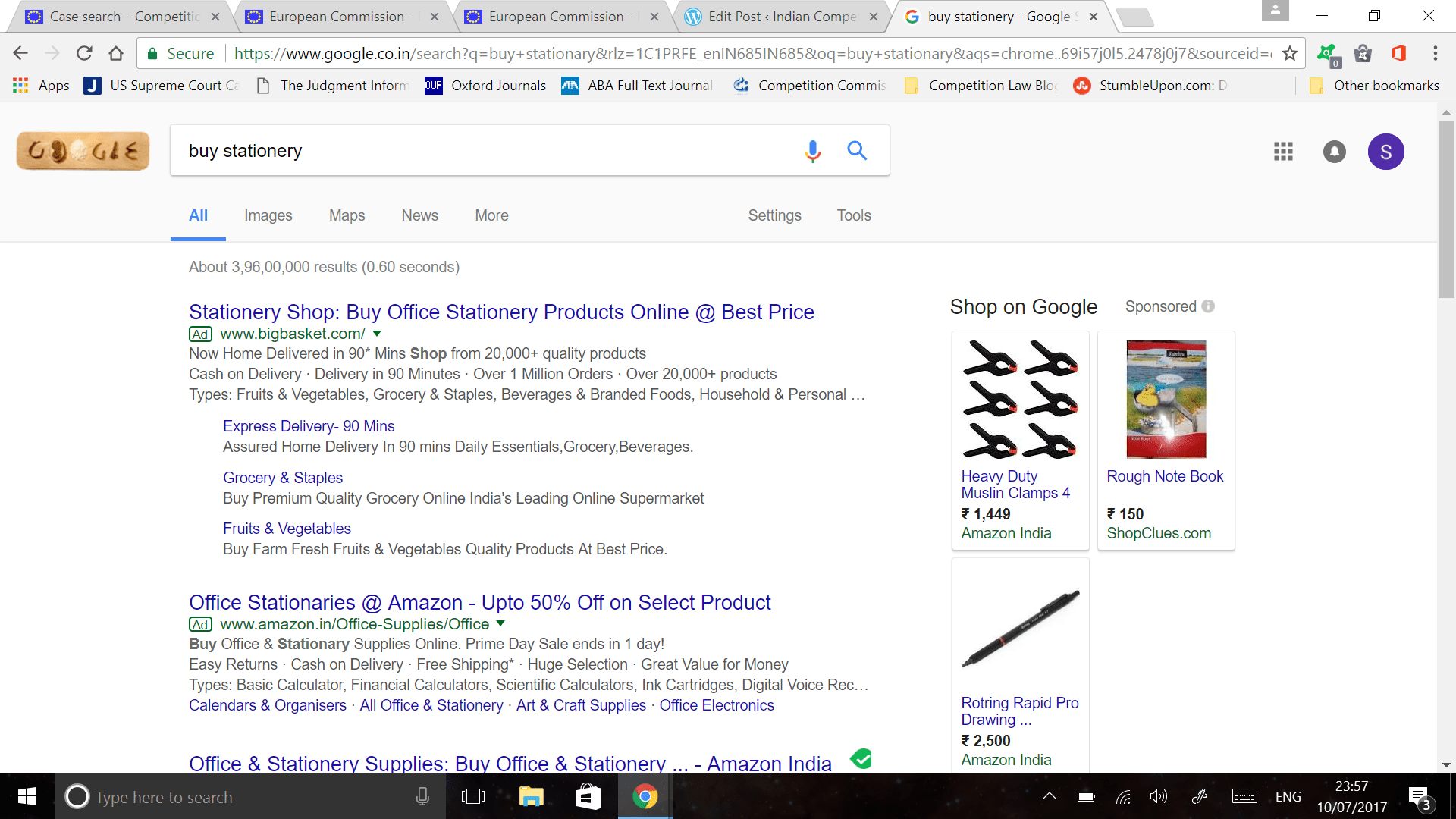
Google Shopping 1


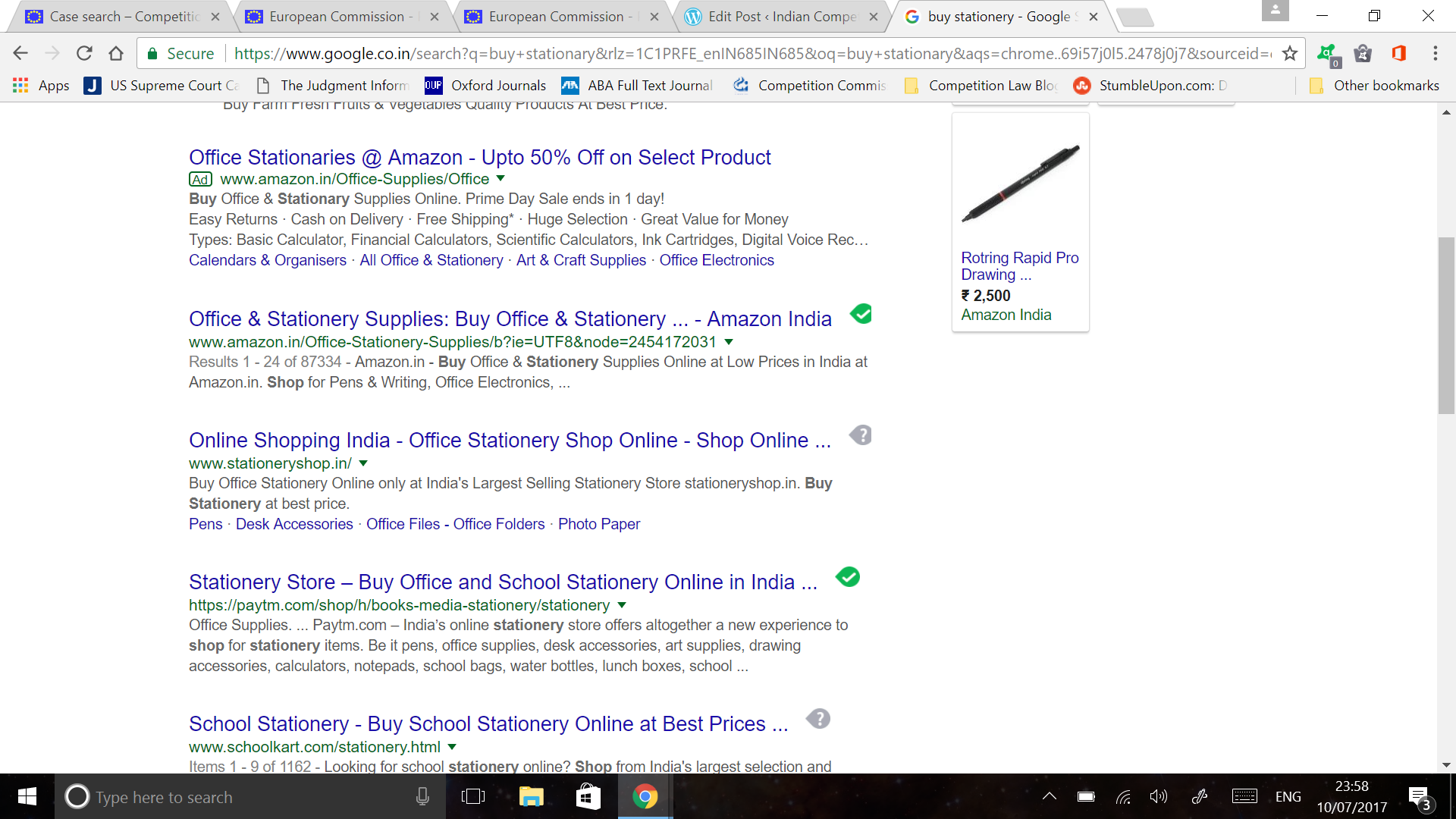
Google Shopping 2

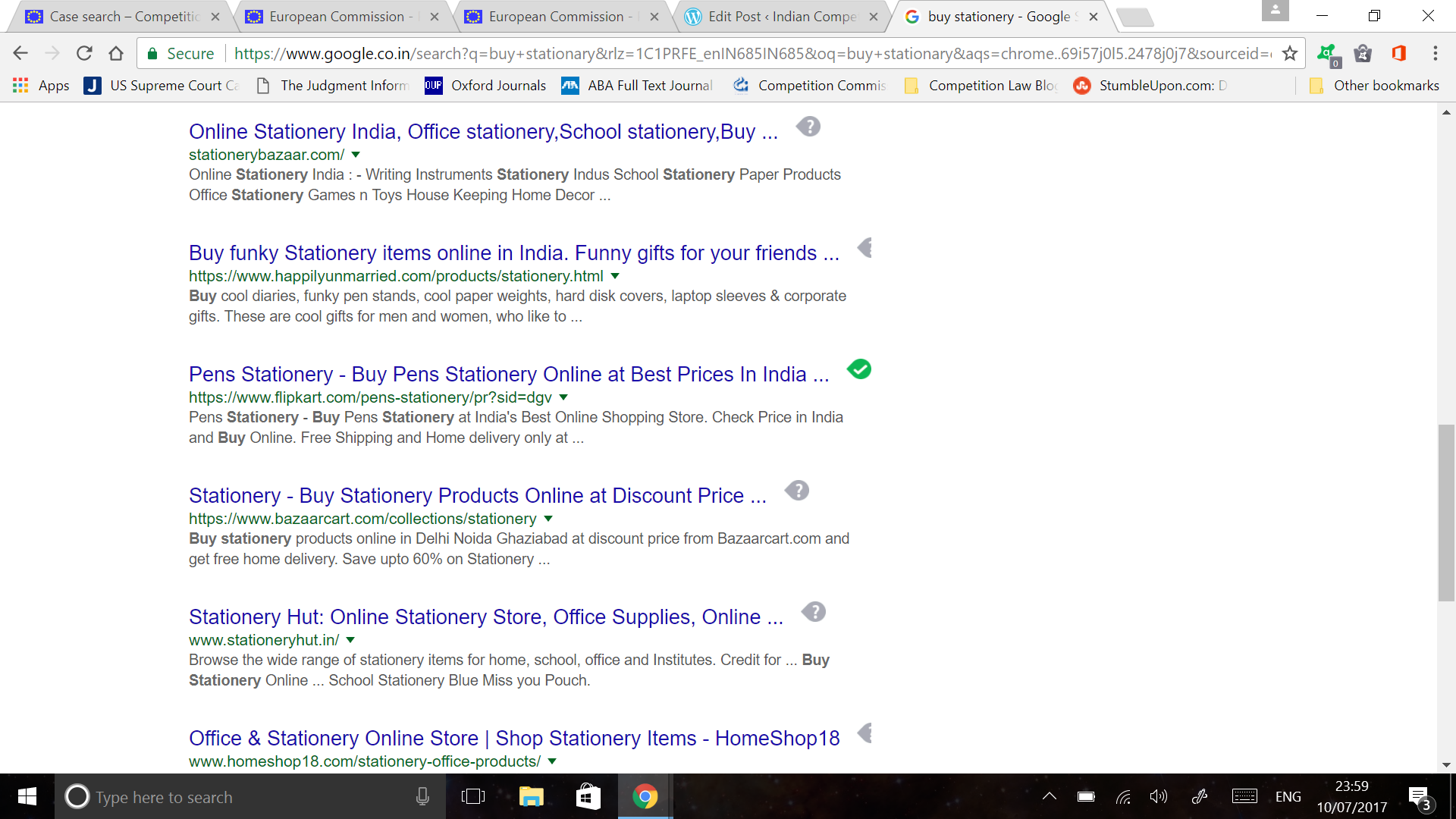
Google Shopping 3

Google Shopping 4

(Above: Google Shopping India: Personal experience on experimentation.)

2. From the above, the relevant market as per the Commission appears to be that of “shopping comparison websites/services”. The question to ask is, is there really such a definitive market in existence ?? Somehow, no matter which way one tries to describe it, it appears to be hard to cogently define it. After all, comparison of products can be done through the regular search, or they can be done through the individual websites, or they can be done through individual Applications (in the case of smartphones). Personally, I hardly used the Google results which appeared on the side. I (and perhaps many others) end up directly clicking on the “trusted/preferred” website (Amazon India, Flipkart, Ebay.in) and search directly for the product by jumping between these sites (not to mention to multiple options available on each individual website). It’s important to note that these website results do almost always come up among the top five to ten results on the first page, hence the lack of use of the Google Shopping. (See the pictures above as an example)

3. The fundamental premise of competition law, both in India as well as the E.U., is that any appreciable adverse affect on competition in the relevant market or abuse of dominance results in a harm to consumers. In the present case, however, was Google Shopping really so bad ?? Is there really an adverse affect on competition or an abuse of dominance ?? As already stated, the results which pop up under Google Shopping (which, it must be noted, are clearly differentiated),  are merely the most relevant websites where you would find the product. And consumers do appear to be have A LOT of choice in the alleged relevant market. So even if the sponsored results do pop up on the side, does it really hurt anybody at all ?? In fact, from the Press Release, it appears that even the Commission is not sure if there is any actual detrimental affect on consumers, but rather only states “Google’s comparison shopping service [sic] make[s] significant gains in traffic at the expense of its rivals and to the detriment of European consumers.” A rather vague statement, but then, that may be because it is only a Press Release.

Google’s troubles in Europe are far from over. The Android Operating System and the Adsense cases are still pending, and the trend appears to be against the company. The three cases together could well become the triumvirate against what was once considered (and arguably still is), the most innovative company in the world.