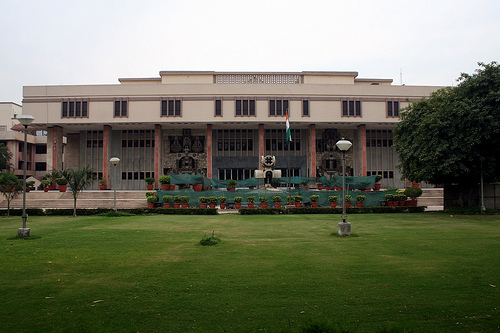
W.P.(C) 993/2012 and C.M. Nos. 2178-79/2012, Union of India v. Competition Commission of India

A commentator on a previous post recently  brought to my attention a recent judgement of the Delhi High Court in which the hon’ble Court chose to deal with the concept of what would constitute “a sovereign function”. (W.P.(C) 993/2012 & C.M. Nos. 2178-79/2012, Union of India  v. Competition Commission of India)

The Court in this case discussed the Supreme Court judgement’s of Common Cause v. Union of India, (1999) 6 SCC 667  and Agricultural Produce Market Committee Vs. Ashok Harikuni & Another, (2000) 8 SCC 61  where the Supreme Court held that sovereign functions in the new sense may have very wide ramifications, but essentially sovereign functions are primarily inalienable functions which only the State could exercise. It was also observed by the Court, quoting from the petitioners brief that:

“….it appears that the courts have taken a very narrow view of the term “sovereign function” by confining the same to strict constitutional functions of the three wings of the State. Welfare activities, commercial activities and economic adventures have been kept outside the purview of the term “sovereign functions”.”

While the judgement’s of the Supreme Court and the Delhi High Court may serve as effective guidelines for the government to help determine what sovereign functions should be exempted under the Act, I strongly  feel that it is in the end the sole prerogative of the Central Government to determine what enterprises and their sovereign functions, if any, should be exempted under the Act.  In fact, even a non – sovereign function of an enterprise may be exempted from the CCI’s jurisdiction by the government under Section 54(a) of the Act.

It should be noted that the Court was in fact in a way, forced to discuss this issue due to the contentions advanced by the Petitioner and that the actual issue was whether the function being performed by the governent could be classified as an “enterprise” under Section 2(h) of the Competition Act.

And Others May Bite the Dust !!

And others shall bite the dust !! What with the CCI initiating suo moto investigation against milk retailers, not to mention, to quote Mr. Chawla, Chairman of CCI

 “Real estate, pharmaceuticals, aviation, telecom and tyre industries are on our radar. The inquiry against tyre companies is in an advanced stage and a decision can be expected soon”

The CCI has a busy monsoon ahead !! However, the intention of this post is to specifically focus on the investigation by the DG against automobile companies.  Assuming the facts in the article are true, and please note, the opinion is based strictly on the article’s contents, the odds seem to be heavily stacked against the respondents. Such agreements are unanimously considered as anti-competitive throughout all jurisdictions (See Eastman Kodak Co. v. Image Tech. Svcs., 504 US 451 (1992) and Standard Oil Co. of California v. United States337 US 293 (1949) ). Also, see COMMISSION REGULATION (EU) No 461/2010 of 27 May 2010 on the application of Article 101(3) of the Treaty on the Functioning of the European Union to categories of vertical agreements and concerted practices in the motor vehicle sector.

Closer to home, Both the cases of Tata Engineering & Locomotive Co. Ltd. v. Registrar of Restrictive Trade Practices, [1977] 2 SCR 685  and Mahindra & Mahindra Ltd vs Union Of India & Anr, 1979 SCR (2)1038 dealt with a similar issue.

Indian Competition Law’s Dark Night. (A Post Script)

Just two queries to be asked in this post script to the previous post:

1. A valid contention was raised by one of the respondents on page 78 of the Order that the prices of Cement Corporation of India, a PSU, also rose along with the other respondent manufacturers. However, the DG did not take notice of this fact. A fair question. Why ??

2. Exactly why have large portions of the data published in the Order been hidden (crossed out to be specific) ?!

Any suggestions ??

Indian Competition Law’s Dark Night.

The analogy might seem stupid or funny to many, but I just couldn’t help but remember the movie Batman Begins while reading the news about the CCI’s Cement Cartel Decision. Think about it, just like the Batman, there are now those who love the CCI,  proud that someone decided to teach the big corporations a lesson, and there are those who hate the CCI, who are not only crying themselves hoarse on the injustice meted out to the Cement Manufacturers’ Association (CMA) and its affiliated companies and who will surely appeal to the COMPAT, and if required, even the Supreme Court.

While I do support the decision (a day may come when I shall become Anti- CCI, but it is not today and shall probably not come for quite some time), there are a few questions or points which do  merit consideration, just for the sake of clarification, if nothing else. They are as follows:

1.  Almost all the companies as respondents have contended that there profits actually fell for the period in consideration, and hence, no benefit actually accrued to the companies who were allegedly members of the cartel. Even assuming that this is true, the argument is irrelevant under competition law. The U.S. Supreme Court held as far back as 1927 in United States v. Trenton Potteries Co. et. al., 273 US 392 (1927) that

“the aim and he aim and result of every price-fixing agreement, if effective, is the elimination of one form of competition. The power to fix prices, whether reasonably exercised or not, involves power to control the market and to fix arbitrary and unreasonable prices….Once established, it may be maintained unchanged because of the absence of competition secured by the agreement for a price reasonable when fixed. Agreements which create such potential power may well be held to be, in themselves, unreasonable or unlawful restraints without the necessity of minute inquiry whether a particular price is reasonable or unreasonable as fixed and without placing on the government”

The decision was further affirmed in United States v. Socony-Vacuum Oil Co., 310 US 150 (1940) wherein it was observed

“Any combination which tampers with price structures is engaged in an unlawful activity. Even though the members of the price-fixing group were in no position to control the market, to the extent that they raised, lowered, or stabilized prices, they would be directly interfering with the free play of market forces.”

2. Circumstantial Evidence also seems to have become a bone of contention with every respondent contending that the circumstantial evidence is not good enough to prove a cartel. This IS a contentious issue since the use of circumstantial evidence in competition law is as of now debatable. I would prefer to let the OECD do the talking on this subject, through their excellent policy roundtable paper on the same. The key point to note is that their primarily two forms of circumstantial evidence, communication evidence and economic evidence. Of the two, communication evidence is considered to be the more important as economic evidence is often ambiguous due to the multiple interpretations available for the same. This is more than evident in the Order itself, wherein a number of respondents have relied on the affidavits and expert opinion of economic experts to substantiate their case. ( One sees to get the impression that all of them have their own opinion regarding the same !! 😀 Also, pages 156 and 157 of the Order speak on the Commissions decision of circumstantial evidence).

3. There is a prickly issue in the claim that the collection of the information was asked by the government itself, and that after the closure of the Office of Development Commissioner of Cement Industry (DCCI) in 1989, the CMA was directed by the Department of Industrial policy and Promotion to collect and submit data which was earlier collected by the DCCI. Now Section 54 clearly allows the Central Government, by notification to exempt any enterprise or class of enterprises from the provisions of the Act where that enterprise performs a sovereign function on behalf of the Central Government. Also, in case an enterprise is engaged in any activity including the activity relatable to the sovereign functions of the Government, the Central Government may grant exemption only in respect of activity relatable to the sovereign functions. The collection of such information by the CMA for the Ministry of Commerce can be interpreted as the performance of the sovereign function for the Central Government. The catch: I could not find any notification issued by the Central Government published in the Gazette which grants such an exemption to the CMA. If the respondents possess one, then good for them. It will be a very strong argument before the COMPAT.

4. I don’t see the relevant market issue ( See pages 184 and 233 of the Order) as a serious problem as long the evidence points to a general collusion. However, only further proceedings before the COMPAT help us understand this issue better.

Some Thoughts on Cartels in India

This post arises out of the often lengthy (and occasionally extremely annoying to others!!) bouts of brooding which often hijack my head. Though the subjects of such musings are mixed and varied, this particular one was specifically on competition law. Eventually, the contemplation became more subject specific, i.e., on cartels in India. Therefore, I pen my thoughts below and invite an active discussion on the issues  regarding the same.

1. Under Section 27(b) of the Act, the Commission can impose a penalty against any cartel which shall not be more than ten percent, of the average of the turnover for the last three preceding financial years upon each person or enterprise involved in any such a cartel. The Question: Will ten percent really be enough to deter any cartel formation ?? Allow me to explain. It is now accepted that the level of sanctions should be of such amount so as to deter crime.  A high level of sanction therefore, contributes to minimise the costs of enforcing the law as a high penalty acts as an effective deterrent to crime. Now when it comes to a cartels, a firm shall only participate in such collusion depending on the advantage it may derive from such a cartel. Obviously, if the profits are not worth the risk, why bother to step on the shoes of the law in the first place ?!?! Now, even with the imposition of penalty (which to be noted cannot exceed ten percent as per Section 27(b)), would this clause of a ten percent limit on an imposition of the penalty actually act as a deterrent in the effective enforcement of the law ??

To take a hypothetical example, lets say four firms decide to enter into a cartel sensing to grab the opportunity to abuse their combine domination on the market. The Cartel presumably,  is not discovered for atleast two years (its a lot harder than one would like to believe), and in the meantime each firm manages to garner a turnover/revenue of approximately 400 crore for each year.   Therefore, for the two years, a turnover of 800 crore. The year before that (which would be required to calculate the penalty), on an average, each company use to make an average turnover/revenue of 200 crore. Therefore, an average of of the three years – 333 crore(approx.). Therefore, ten percent of this amount would result in 33.3 crore penalty on each firm. A paltry and insignificant sum as compared to the 400 crore advantage each firm derived in the two years of the existence of the cartel. Therefore, where and how does it create a deterrence amongst firms to engage in such future cartelisation , when it is more than obvious that irrespective of the penalties, the firms shall make a profit ?!?!

(Update: Of course, as it turns out, the above was a redundant questions as I completely forgot to take into account the proviso to Section 27(b) which does provide a solution to the dilemma. An unfortunate consequence of writing posts half asleep !! Deeply apologise for the error as regards cartels. However, the theory would still hold true for other anti – competitive arrangements.)

2. Should the Commission (and the DG of investigation) adjust penalties and sanctions by granting the incentive to one or more members of the cartel to undercut each other ?? Simply put, undercutting in cartels is allowing one firm an exemption from a probable penalty for participation in a cartel by encouraging it to break the cartel by offering their goods at lower prices than the collusive price among member of the cartel. Its not a tactic that Commission has used till now, but it should consider using such innovative methods if it intends to maintain competition in the market and still be able to effectively conduct investigations and pass orders in a reasonable time and prevent a backlog of cases, which is   unfortunately, more than prevalent among other Courts and Tribunals in the Country.

Why the Communications Sector Should not be Exempted From the Competition Act.

Communications Today reported on 19th March, 2012 that the Telecom Department will ask the Union Cabinet to exempt the communications sector from the country’s Competition Act. According to the article, “the move comes after the competition watchdog-Competition Commission of India (CCI)-recently raised the red flag over the telecom ministry’s plans to allow mergers and acquisitions (M&As) if the combined market share of merged mobile phone companies was less than 60 percent.”

We shall not comment upon the logic or exigencies which compel the Telecom Department to make such a demand but shall only list below point by point reasons the reason why we feel the Telecommunications sector should not be exempted under the Competition Act, irrespective of the complaints which support the request. They are as follows:

1. As of December, 2011. there were exactly fifteen different players in the Sector (Bharti Airtel, Reliance Comm., Vodafone India, Idea Cellular, BSNL, Tata Teleservices, Aircel, Uninor, Sistema Shyam Teleservices, Videocon Tele, MTNL, S Tel, Loop Telecom, Etisalat DB, HFCL). Granted, there are maybe players one too many in the sector, but the fact remains that six of the above are extremely small players, with atleast two of them confirmed to be losing subscribers as per TRAI. Only the first eight are predicted by analysts to be major market players in the sector, and it is expected that these players shall in all probability fade away on their own.   This is exactly what is envisaged in a competitive sector. The players in the relevant market which fail to grow and develop themselves in the relevant market should leave.

2. Continuing from the above, talking from the consumers perspective, tariff rates in the telecom sector in India can hardly be considered as an issue as frankly, they are one of the lowest in the world and even if assuming that they are raised in the near future, users can well afford the market rates, despite the recent cease fire in price wars. Admittedly, quality of service is a problem,  but the reason for that is primarily lack of infrastructure rather than excess of competition, and merging companies shall certainly not help improve the same. What is required is some seriously heavy investment in infrastructure, rather than simply buying out smaller players in the market, and additionally maybe even some corporate restructuring.

3. The Supreme Court has recently cancelled all 2G licenses issued during A. Raja’s tenure as Minister of Telecommunications. With the Judgement it self being questionable as regards its ratio and till a certain extent, its reasoning, and at the same time a Presidential reference also having been filed asking for clarifications to the same, it is best to follow a wait and watch policy and act only after receiving the Supreme Court’s reply on the Reference.

4. As per the Economic Times, there is a new round of Spectrum wars that’s about to begin with the upcoming re-auctioning of spectrum. Again, it is best to wait till the conclusion of the auction before deciding on such issues.

5. Clause 5(3) of the The Competition Commission of India (Procedure in regard to the transaction of business relating to combinations) Regulations, 2011 provides that form may be filed preferably where “the parties to the combination are engaged in production, supply, distribution, storage, sale or trade of similar or identical or substitutable goods or provision of similar or identical or substitutable services and the combined market share of the parties to the combination after such combination is more than fifteen percent (15%) in the relevant market”. In light of this sub-clause, it is best to maintain harmony between various government policies  and the Act and regulations made under it in order to prevent unnecessary conflicts and confusion between the CCI, the Government and the Industry. In fact, the government, in its National Competition Policy, has sought to bring about harmony between the Act and policies and has suggested an elaborate mechanism to achieve the same.

6. Finally, if such an exemption is allowed, it will set a bad precedent in general and may encourage industries to lobby for exemptions in their favour.

The source of all data and statistics is The Economic Times 

India Finally Starts to Open its Eyes !! :)

India has finally started opening its eyes towards the principle of Network Neutrality and its potential violation !! The Economic Times yesterday carried an excellent article on the subject. We strictly feel its about time the issue started gaining prominence in our Country !!

For previous posts o network neutrality on this Blog, see here, here and here.

Press Statement by the Ministry of Corporate Affairs

The ministry of Corporate Affairs, Government of India, released a press statement yesterday stating that “the Competition Commission of India has started facilitating competition assessment of rules, regulations and government policies, contents of which may inadvertently impact the competitive atmosphere adversely.” It also stated that the process was for “evaluating government policies, regulations, rules and laws for identification of those which unnecessarily impede competition and suggest measures to redesign the identified ones so that competition is not unduly inhibited.”

The task has been assigned to the CCI with the intention to begin implementation of the National Competition Policy (Apologies. Unfortunately, the latest draft seems to have disappeared off the internet. Will update this post as soon as it is found.)

The press statement can be found here