
Note On Competition/Anti-Trust Law and its Efficacy in Tackling Issues Concerning Privacy (Part III) – And a Post Script.

[The previous post seemed way too long for a blog post, so decided to split it and post a ‘Part III’. The previous posts can be found here and here. Also as a bonus – an anticlimax post script. ;)]

INDIA

As already stated above, India has also till date been following the traditional model of competition law enforcement. The language and the concepts of the Competition Act, 2002 are heavily borrowed from the Treaty on the Functioning of the European Union (T.F.E.U.) and the enforcement structure enumerated under the act, i.e., the Competition Commission of India (C.C.I.) and the Director General of Investigations (D.G.) is also similar to the enforcement structure of the E.U.

The Commission displayed its cognizance of data collection, though not from a Privacy perspective, in the case of Matrimony.com Ltd. v. Google LLC, Case No. 07 of 2012. In its Final Order dated 31.01.2018, while imposing a fine of Rs. 135.86 crores on Google, it observed:

“In fact, it would not be out of place to equate data in this century to what oil was to the last one. The Commission is not oblivious of the increasing value of data for firms which can be used to target advertising better. Moreover, the data can be turned into any number of revenue generating artificial-intelligence (AI) based innovations.”

However, prior to this, in the case of Vinod Kumar Gupta v. WhatsApp Inc., Case No. 99 of 2016, specifically assailing the acquisition and the privacy policies of the respective entities, the Commission while dismissing the Complaint, specifically observed:

“14. On the issue of dominance of the OP in the relevant market as defined supra, the Commission notes that in India a number of other players such as Apple with iMessage, BlackBerry with BBM, Samsung with ChatON, Google with Google Hangouts and Microsoft with Skype are providing consumer communication apps and are also active in the provisions of smartphone hardware and operating systems. Besides, many other consumer communication apps providers such as Hike, Viber, WeChat and Snapchat are also active in market. As per the information available in the public domain, globally ‘WhatsApp’ is having a billion monthly active users and within India, it is having 160 million monthly active users. According to a study of ‘Jana and mCent’, 97% of the smartphone users in India use a communication app daily and the most popular is ‘WhatsApp’, which is installed on 96% of devices and has more daily active users than any other communication app in India. As per the said report, ‘WhatsApp’ is installed in 2.3 times more devices than home-grown messaging app Hike. According to a study conducted by ‘TNS/TNC Connected Life Study 2015’, 56% of the internet users in India use ‘WhatsApp’ and 51% use ‘Facebook’ every day. Further, amongst India’s internet users, ‘WhatsApp’ tops the list of instant messaging apps. Further, citing a study conducted by Global Web Index, the Informant has submitted that 64% of mobile users in India use ‘WhatsApp’ which is the largest as compared to any other mobile messaging app usage. Based on the the above, the Commission is of the opinion that the OP is in a dominant position in the relevant market as defined under para 13 above.

15. With regard to the abusive conduct of the OP in the relevant market, it is noted that the Informant has alleged that the OP is abusing its dominant position in the relevant market by introducing privacy policy which compels its users to share their account details and other information with ‘Facebook’. In this regard, the Commission observes that the data sharing terms of the privacy policy of the OP as updated on 25th August, 2016 relate to sharing of users’ ‘WhatsApp’ account information with ‘Facebook’ to improve the online advertisement and products experiences available on user’s ‘Facebook’ page. It is noted that the OP provides the option to its users to ‘opt out’ of sharing user account information with ‘Facebook’ within 30 days of agreeing to the updated terms of service and privacy policy. Moreover, the OP has submitted that ‘Facebook family of companies’ will use such information for the purpose of improving infrastructure and delivery systems, understanding how their services are used, securing systems, and fighting spam, abuse or infringement activities. The Commission also finds force in the submission of the OP regarding its users safeguards that all types of ‘WhatsApp’ messages (including chats, group chats, images, videos, voice messages and files) and ‘WhatsApp’ calls are protected by end-to-end encryption so that third parties and ‘WhatsApp’ cannot read them and also the message can only be decrypted by the recipient. Further, as stated in the key updates summary of the OP, nothing a user shares on ‘WhatsApp’, including his/ her messages, photos, and account information, will be shared onto ‘Facebook’ or any other apps of ‘Facebook family of companies’ for any third party to see, and nothing a user posts on those apps will be shared by ‘WhatsApp’ for any third party to see.

……..

19. The Commission also observes that there are no significant costs preventing the users to switch from one consumer communication apps to another. It may be due to the following reasons: (i) all consumer communication apps are offered for free of cost or at a very low price (mostly free), (ii) all consumer communication apps are easily downloadable on smartphones and can co-exist on the same handset (also called ‘multi homing’) without taking much capacity along with other apps, (iii) once consumer communication apps are installed on a device, users can pass on from one app to its competitor apps in no-time, (iv) consumer communication apps are normally characterised by simple user interfaces so that costs of switching to a new app are minimal for consumers, and (v) information about new apps is easily accessible given the ever increasing number of reviews of consumer communication apps on apps store like google play store etc. Furthermore, the expansion of Hike Messenger to nearly 100 million user base within three years of launching their services into the aforesaid market reflects that in this market, there are no significant barriers to entry and consumers appear to be price sensitive. Based on the above, the Commission is of the view that even though ‘WhatsApp’ appears to be dominant in the relevant market, the allegations of predatory pricing have no substance and the OP has not contravened any of the provisions of Section 4 of the Act.”

The most comprehensive discussion by the Commission on the aspect of data collection and sharing appears to be under the combination procedure in the Jhaadu Holdings LLC Case, i.e., the Acquisition of 9.99 percent of the equity share capital in Jio Platforms Limited by Facebook, Inc. The relevant portions of the Order of the Commission dated 24.06.2020 are as follows:

“(ii) Potential data sharing between the parties

50. Most of the data driven businesses are multi-sided platforms where one or more sides of the platform is designed to attract user presence and the other sides are used for monetizing the data relating to user behaviour. For instance, Facebook application is a social media platform. One side of its platform offers free services to users for social interaction and on the other side, the monitored behaviour of the users is used as an input to offer advertisement services (targeted display ads). As noted earlier, the social media and other applications of Facebook group are popular amongst internet users and Facebook is expected to have access to rich data regarding user behaviour. Facebook has submitted that it has a data policy that explains the nature of information collected by Facebook and how it is being used. It inter alia explains data sharing with third party partners.

51. Jio Platforms including RJIO, on the other hand, is also in a position to collect and possess consumer data. The privacy policy of RJIO defines Non-Personal Information as information that does not identify the user or any other individual, and includes session, web beacons and usage and transaction data, aggregate log data and aggregate information. It further states that RJIO uses this information, inter-alia, to tailor its services to the interests of its users, to measure traffic within its services, to improve the quality, functionality and interactivity and let advertisers know the geographic locations from where its users/ visitors come. The privacy policy further provides that the information provided by the users will be used for a number of purposes connected with RJIO’s business operations including (a) verifying the identity, access, privileges assigned and relationship with the user; (b) provisioning of products/services, testing or improvement of services, recommending various products or services; (c) communicating about bills, invoices, existing or new offers, content, advertisements, surveys, key policies or other administrative information; (d) analytics and reviews for improvement of RJIO’s services; (e) improving user experience while using RJIO’s services by presenting tailored advertising, products and offers; and (g) other usages that users may consent to.

52. Business combination between entities having access to user data can be analysed from the perspective of data backed market power. The assessment in such instances needs to focus on the incentives of parties to pool or share their databank and monetize such data in possible means.

53. In the instant matter, it is noted that the Proposed Combination is an acquisition of 9.99% stake in Jio Platforms by Facebook group. This may not result in unrestricted access to each other’s resources including user data. Nevertheless, the parties may have incentives to engage in mutually beneficial data sharing. In this regard, Jaadhu has submitted that “there is no data to be shared as part of the Proposed Transaction” (i.e. proposed acquisition of shares in Jio Platforms by Jaadhu). It has been further clarified in the response dated 12th June, 2020 by Jaadhu that:

“It is clarified that data sharing is NOT the purpose of the Proposed Commercial Arrangement, nor will either side be acquiring ownership of the other’s data pursuant to the Proposed Commercial Arrangement. However, for implementation of the Proposed Commercial Arrangement, WhatsApp and JioMart (which is owned by RRL and operated by Jio Platforms) will receive or send limited data. This data is:

(i)being provided only for the purpose of facilitating e-commerce transactions on JioMart. Its use is limited, proportionate and solely for the purpose of implementing the Proposed Commercial Arrangement. Further, ****** the MSA explicitly prohibits the Commercial Arrangement Partners from using confidential information received from the other party for their own business purposes, or from disclosing it to third parties, *********************************************** ********************************************************** ********************************************************** ************************************************;

(ii)neither exclusionary, inimitable nor rare, and substitutes exist…; and

(iii)processed in accordance with applicable law and parties’ data policies.”

54. The Commission observes that RJIO is a prominent telecommunication player in India with more than one-third of wireless subscribers on its network. The group entities of Jaadhu viz. Facebook Group, on the other hand, are the second leading player in online advertisement space and leading player in online display advertisement services. The user data possessed by Jio Platforms including RJIO and Facebook Group are complementary to each other given the symbiotic interface between telecommunication business and OTT content/ application users. Thus, any anti-competitive conduct resulting from any data sharing in the future could be taken up by the Commission under Sections 3 and/or 4 of the Act having due regard to the dynamics of the concerned markets and position of the parties therein.

55. Considering the material on record including the details provided in the Notice and the assessment of the Proposed Combination based on factors stated in Section 20(4) of the Act, the Commission is of the opinion that the Proposed Combination is not likely to have any appreciable adverse effect on competition in India. Therefore, the Commission approves the Proposed Combination under Section 31(1) of the Act. The Commission also notes that the parties confirm that the Proposed Combination does not contemplate any non-compete covenants.

56. This order shall stand revoked if, at any time, the information provided by Jaadhu is found to be incorrect.”

Recently, the Chairman of the C.C.I, Ashok Kumar Gupta, remarked that “Lowering of privacy protection by dominant enterprises could be construed to be an abuse of dominant position and therefore fall within the ambit of antitrust as low privacy standards implies reduction in consumer welfare.” However, no fresh investigation appears to have been initiated by the regulator as on date.

P.S. (As promised) –

So we have a bit of an anti-climax in this space, with TechCrunch reporting day before yesterday through Natasha Lomas that Google won’t end support for tracking cookies unless UK’s competition watchdog agrees !! It’s a long article, but well worth the read, especially for grasping the contours of Google’s self-styled “Privacy Sandbox” it announced earlier this year.

My favourite portion was and I quote:

But the key issue here is how privacy and competition regulation interacts — and potentially conflicts — with the very salient risk that ill-thought-through and overly blunt competition interventions could essentially lock in privacy abuses of web users (as a result of a legacy of weak enforcement around online privacy, which allowed for rampant, consent-less ad tracking and targeting of Internet users to develop and thrive in the first place).

Poor privacy enforcement coupled with banhammer-wielding competition regulators does not look like a good recipe for protecting web users’ rights.”


Note On Competition/Anti-Trust Law and its Efficacy in Tackling Issues Concerning Privacy (Part II).

Continued from our previous post:-

EUROPEAN UNION (E.U.)

In the E.U., the European Commission (E.C.) and its Directorate General for Competition are responsible for the administration of competition law. In regard to privacy matters, the General Data Protection Regulation is regulated by the European Data Protection Board. European authorities have also had the opportunity to deal with data implications on several occasions.

Initially, in the 2014 Facebook-WhatsApp Merger Case, Case No. COMP/M.7217 it took at extremely conservative approach on the issue of privacy. To quote from the Commission’s Order itself:

“For the purposes of this decision, the Commission has analysed potential data concentration only to the extent that it is likely to strengthen Facebook’s position in the online advertising market or in any sub-segments thereof. Any privacy-related concerns flowing from the increased concentration of data within the control of Facebook as a result of the Transaction do not fall within the scope of the EU competition law rules but within the scope of the EU data protection rules.

On the other hand, in 2016, in the Microsoft-Linkedin Merger Case, Case M.8124 the E.C. approved the acquisition of LinkedIn by Microsoft, subject to several conditions. Both companies retained large datasets comprised primarily of personal information. The E.C. found that the combination of Microsoft’s and LinkedIn’s datasets would act as a barrier to entry. The E.C.’s commitments included granting competing professional social network service providers access to Microsoft Graph, a gateway for software developers which is used to build applications and services that can, subject to user consent, access data stored in the Microsoft cloud, such as contact information, calendar information, emails etc. Software developers can potentially use this data to drive subscribers and usage to their professional social networks. Simply put, the Commission considered Privacy as a parameter for non-price competition Interestingly, the F.T.C. did not find anticompetitive implications in this transaction.

However, it is in fact the German Competition Authority Bundeskartellamt, and subsequently the Federal Court of Justice of Germany which have taken the first proactive to privacy protection through competition law.

In its decision of 6 February 2019 the Bundeskartellamt prohibited Facebook Inc., Menlo Park, USA, Facebook Ireland Ltd., Dublin, Ireland, and Facebook Germany GmbH, Hamburg, Germany from making the use of the Facebook social network by private users residing in Germany, who also use its corporate services WhatsApp, Oculus, Masquerade and Instagram, conditional on the collection of user and device related data by Facebook and combining that information with the Facebook.com user accounts without the users’ consent. The prohibition was based on Section 19(1) of the German Competition Act. The prohibition also applied to terms making the private use of Facebook.com conditional on Facebook being able to combine information saved on the “Facebook account” without the users’ consent with information collected on websites visited or third-party mobile apps used via Facebook business tools and use this data. The Court concluded that there was no effective consent to the users’ information being collected if their consent is a prerequisite for using the Facebook.com service in the first place.

The Bundeskartellamt found Facebook had abused its market power based on the extent of collecting, using and merging data in a user account and imposed on Facebook far-reaching restrictions in the processing of user data. The Bundeskartellamt saw the use of the conditions of use as an abuse of dominant position. It found Facebook dominant in the national market for the provision of social networks. It abuses this position by, contrary to the provisions of the General Data Protection Regulation (G.D.P.R.), making the private use of the network dependent on its authorization to link user and user device-related data generated outside of facebook.com with personal data without further consent of the users. With a resolution dated 06.02.2019, the Federal Cartel Office prohibited Facebook and other group companies from using the corresponding terms of use and processing personal data accordingly. The Federal Court of Justice on 23.06.2020 upheld this decision.

Margrethe Vestager, the current European Commissioner for Competition since 2014, has also recently stated before the European Parliament’s economy committee on Tuesday that there could be scope for “investigating if it’s actually legal for a dominant provider to stop supplying” services, adding that the EU “would have a number of tools to use.”

To be continued further….

Note On Competition/Anti-Trust Law and its Efficacy in Tackling Issues Concerning Privacy (Part I).

The traditional competition/anti-trust law paradigm, both in India and jurisdictions abroad, aims to tackle all abuses under two broad heads:

  • Violations through Anti-competitive agreements
  • Violations through Abuse of dominant position

While action is possible against the first only post the agreement coming into effect, competition law allows action against the second even at a pre-execution stage, through the mergers and acquisitions/combinations regime. 

Furthermore, traditional competition law enforcement (including in India) has till date limited investigations to pricing models of goods and services on the presumption that companies with greater market power are incentivised to monopolise profits by charging more or limiting supplies. However, with the proliferation of “free” services in exchange for information whose hidden cost appears to be evidently a degradation in privacy protection, competition/anti-trust regulators around the world are now required to tackle a different threat to competition posed by digital businesses other than that of cost of goods or services or its demand and supply.

This would help partially explain why as of today, none of the competition/anti-trust investigations and suits which have recently been launched against ‘Big Tech’ companies in the E.U. and the U.S.A. have focused on consumer privacy protection. Google and Facebook have been charged with allegations of abuse of dominant position, but with respect to their commercial conduct against competitors and not against consumers. Apple has been charged with enforcing unfair policies on its App Store against application developers but not for consumer privacy harm. This coupled with an inability to properly understand technology and its stupendously fast evolution in the last two decades has left regulators picking low hanging fruit, i.e., anti-competitive harm which is possible to fit within the block pegs of comprehensible economic theory.

The traditional train of thought across jurisdictions has been that privacy issues are covered under a separate regulatory mechanism and do not fall under the purview of competition law enforcement. There has also been a second train of thought that competition law enforcement and privacy law enforcement cannot go hand in hand, as they are antithetical to each other, i.e., enforcing privacy or data protection leads to the dominance of a select few, thus stifling innovation in markets. However, there is now a developing strain of thought, particularly in the E.U., that compelling a consumer to access a service only on a pre-condition of their acceding to particular terms of agreement could constitute an abuse of dominant position on the part of such a service provider as the user loses the right of self determination or choice, particularly in the context of dominant social media services like Facebook or WhatsApp.

UNITED STATES OF AMERICA (U.S.A.)

Anti-trust enforcement in the U.S. has relied on an adversarial litigation process, mostly guided by the consumer welfare standard, i.e., a focus on lower prices and greater output. This is the primary reason why ‘Big Tech’ companies like Google and Facebook have received virtually no anti-trust scrutiny until recently. In fact, both companies have in response to the litigations raised against them, have countered by saying that the Federal Trade Commission (F.T.C.), the anti-trust enforcement body in the U.S., had cleared their respective acquisitions after careful scrutiny and reopening them or divesting them now would amount to a violation of the sanctity of the law concerning mergers and acquisitions process itself.

The matter of Nielsen Holdings N.V. and Arbitron Inc., FTC File No. 131 – 0058 demonstrates the F.T.C.’s ability to identify the importance of data in merger and acquisition review. By way of background, Nielsen and Arbitron competed in the supply of syndicated cross-platform audience measurement services to media companies and advertisers. The F.T.C. found that access to data posed a significant barrier to entry and obtained a consent order “requiring divestiture of assets to Arbitron’s cross-platform audience measurement services business, including audience data with individual-level demographic information and related technology, and intellectual property.”

Similarly, in The Dun & Bradstreet Corporation Case, FTC File No. 091-0081, the F.T.C. sued The Dun & Bradstreet Corporation, challenging its February 2009 acquisition of Quality Education Data (QED) and alleging that the deal hurt consumers by eliminating nearly all competition in the market for kindergarten through twelfth-grade educational marketing databases. The data sold by these companies was used to sell books, education materials, and other products to teachers and other educators nationwide. The combination of the two companies had given Dun & Bradstreet, through its subsidiary Market Data Retrieval (MDR), more than ninety percent of the market for K-12 educational marketing data, according to the complaint filed by the F.T.C. Dun & Bradstreet acquired QED from Scholastic, Inc. for about $29 million, which was below the threshold amount that would have required the companies to notify U.S. antitrust authorities before finalizing the deal. It ultimately chose to settle the case. The F.T.C. settlement required Dun & Bradstreet to divest certain assets to MCH Inc., an institutional and educational data company active in the K-12 data market, to restore competition that was eliminated as a result of the transaction. Under the terms of the settlement, Dun & Bradstreet sold MCH an updated K-12 database, the QED name, and certain associated intellectual property.

Both these cases clearly display the trend in the U.S.A. The F.T.C. DOES NOT enter into privacy issues when enforcing anti-trust law on data issues. Rather, the trend is rather the opposite – to prevent the monopolisation of data. It is believed, both in academic and enforcement circles, that using anti-trust law to vindicate privacy interests could make it harder for innovative companies to thrive with new products or technology-based offerings and this could potentially result in less competition. Thus, it is not per se considered an anti-trust issue if a company holds a lot of data.

The F.T.C. though has under its Consumer Protection Authority sued Facebook in the past for multiple privacy violations, which ultimately culminated in a five billion dollar settlement in 2019. 

To be continued….

The Best of “Big Tech” (Part – II)

1577122001

Following our previous post from yesterday, listed below is the next set of links. Happy reading !!

Rowland Manthorpe, Google’s Nemesis: Meet the British Couple who took on a Giant, Won… and Cost it £2.1 billion (Wired)

Rahul Matthan, Google’s Play Store Policy isn’t Simply About Toll Charges (Mint)

Manish Singh, Indian Startups Explore Alliance and Alternative App Store to Fight Google’s ‘Monopoly’ (TechCrunch)

Prasid Banerjee, CCI Seeks Investigation on Allegations against Google for Play Billing, Pre-Installation of Google Pay on Android Phones (Mint)

R. Jagannathan, Marx Misread Capitalism but We Must not fall into the Same Trap (Mint)

Kelvin Chan, EU Files Antitrust Charges Against Amazon Over Use of Data (AP)

Katie Canales, Apple was Just Slapped with a Lawsuit that Accuses the Company of Monopolizing the Mobile-Gaming Market by Blocking Apps like Xbox Game Pass and Google Stadia (Business Insider)

AP, Google to Pay $1 Billion Over 3 Years for News Content (Times of India)

Marcy Gordon, For Big Tech, Biden Brings a New Era but no Ease in Scrutiny (AP)

The Best of “Big Tech” (Part – I)

1_q0d3YtCWwrN5D_HQ2iE5sQThe past two months were inundated with articles and opinions on “Big Tech”, to the point that with literally everybody fulminating on their respective (and often repetitive and generic) opinions, I got completely put off from writing any of my own. 

Things seemed to have cooled down for sometime though, with a new administration about to take over in the U.S. and the mundane grunt work of investigations underway elsewhere including India, and I thought why not put out a list of the best and most prominent news events and opinions concerning Big Tech ? So listed below, in no particular Order, are in my personal opinion, some must read reports, write ups and op-eds on all that’s been going on since “Big Tech” became the next giant problem to tackle after Climate Change and Inequality. I may or may not agree with everything that’s been written in these, but its always important to read and attempt to understand views contrary to your own as well. 

Salil Tripathi, Saving the News Biz from Google, Facebook (Mint) 

Cheng Leng, Keith Zhai and David Kirton, China preparing an Antitrust Investigation into Google – Sources (Reuters)

Tom Warren, Microsoft Hits Out at Apple with its New Windows App Store Policies (The Verge) 

Shivdeep Dhaliwal, Microsoft Plans to Skirt Apple Ban on Cloud Gaming Apps Via Browser – Based Service (Benzinga)

Mihir Dalal and Prasid Banerjee, Why Vocal for Local Won’t Bother Google (Mint)

Bloomberg Wire Agency Feed, E.U.’s Failure to Hit Google Where it Hurts is a Lesson for U.S. (Mint)

Ajai Sreevatsan, How Big Tech Reset will Impact India (Mint)

Aaron Holmes, Tech Giants have Skirted Regulation because of how Monopolies are defined by law. Democrats Now Want to Rewrite Those Laws (Business Insider)

Gerrit De Vynck and David McLaughlin, U.S. Antitrust Case Against Google Mimics Lawsuit that Attacked Microsoft (Business Standard – via Bloomberg)

AFP, Google Strikes Payment Deal with French Media (Economic Times)


Collective Dominance in Competition Law

So the people at Virtual Lawyer (Check them out on Instagram and Facebook) recently got in touch to deliver an online talk on a topic of my choosing, and I was more than happy to grab the opportunity to verbally regurgitate on an issue which doesn’t get its due attention, yet which is slowly gaining relevance as the competition climate in our economy changes – Collective Dominance in Competition Law.

My apprehension of it being too niche topic was fortunately belied, as the ‘Question and Answer’ session refused to end and we had to start a fresh meeting to try to go through them all. 🙂 🙂

The links to YouTube videos can be found here and here.

An in case you prefer Instagram IGTV, then here and here.

A big thank you to Virtual Lawyer for letting me rant in public. 🙂

Case No. COMP/C-3/39.740, COMP/C-3/39.775 & COMP/C-3/39.768 – The 2.42 Billion Euro Google Order.

P034802000402-605061


So it’s finally out, and boy is it big !! Well….actually….For Google(Somehow, still can’t bring myself to call it Alphabet. The word is so synonymous with the search engine since times immemorial), monetarily, it’s probably small. 2.42 Billion Euros is peanuts for the Internet behemoth. But what does matter to it is the impact this is going to enough on its products and services not just in the E.U., but throughout the world, which is why it is safe to bet that the company is going to all the way up to the E.C.J. if it has to. Fighting it out is already a forgone conclusion.

So, the following is my preliminary understanding of the Order. Please note though, that the complete text of the Order is not yet out, and so my preliminary opinion is based upon the Press Release, the Fact Sheet, and the Timeline of the case.:


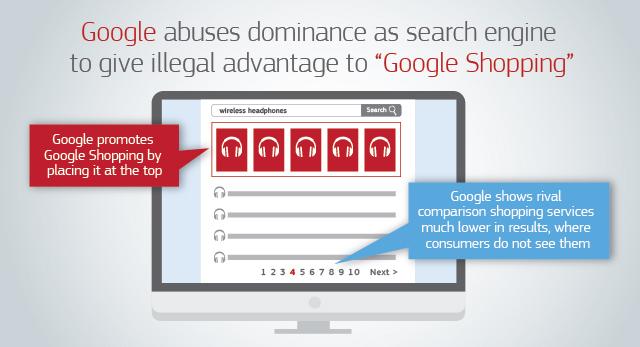
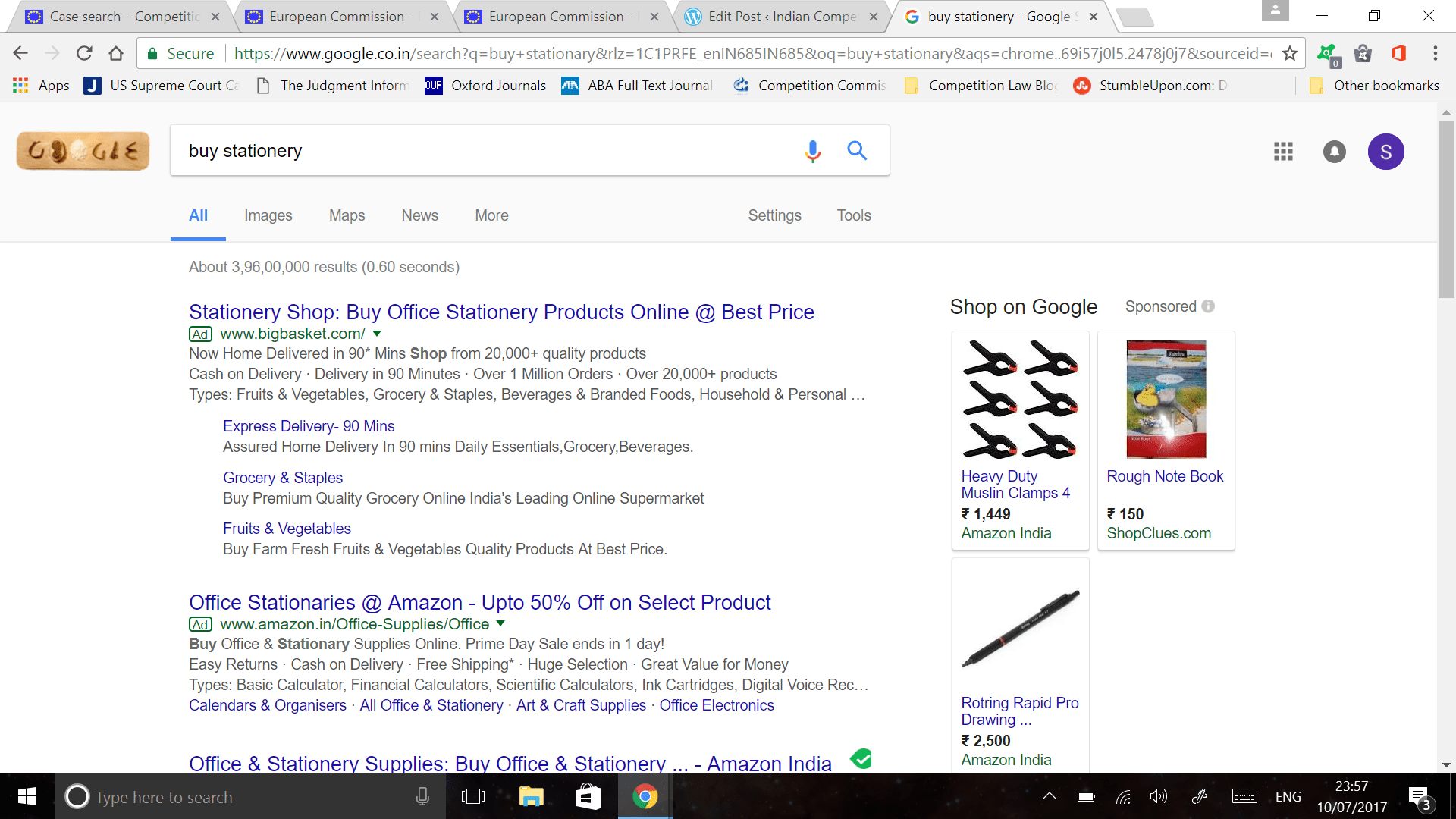
1. The case concerns the display of products on a service called Google Shopping. Now since this service has not been rolled out in India till now, I have never personally had a chance to use it, but from what I have to come to understand (and do feel free to correct me if my understanding is wrong), the product “allows consumers to compare products and prices online and find deals from online retailers of all types, including online shops of manufacturers, platforms (such as Amazon and eBay), and other re-sellers.” (Update: Okay so I just realised that the words typed matter. They must indicate ones intent to purchase a product. So the service has been rolled out in India, but after some experimentation, the results appear to be limited.)

Google Shopping 1


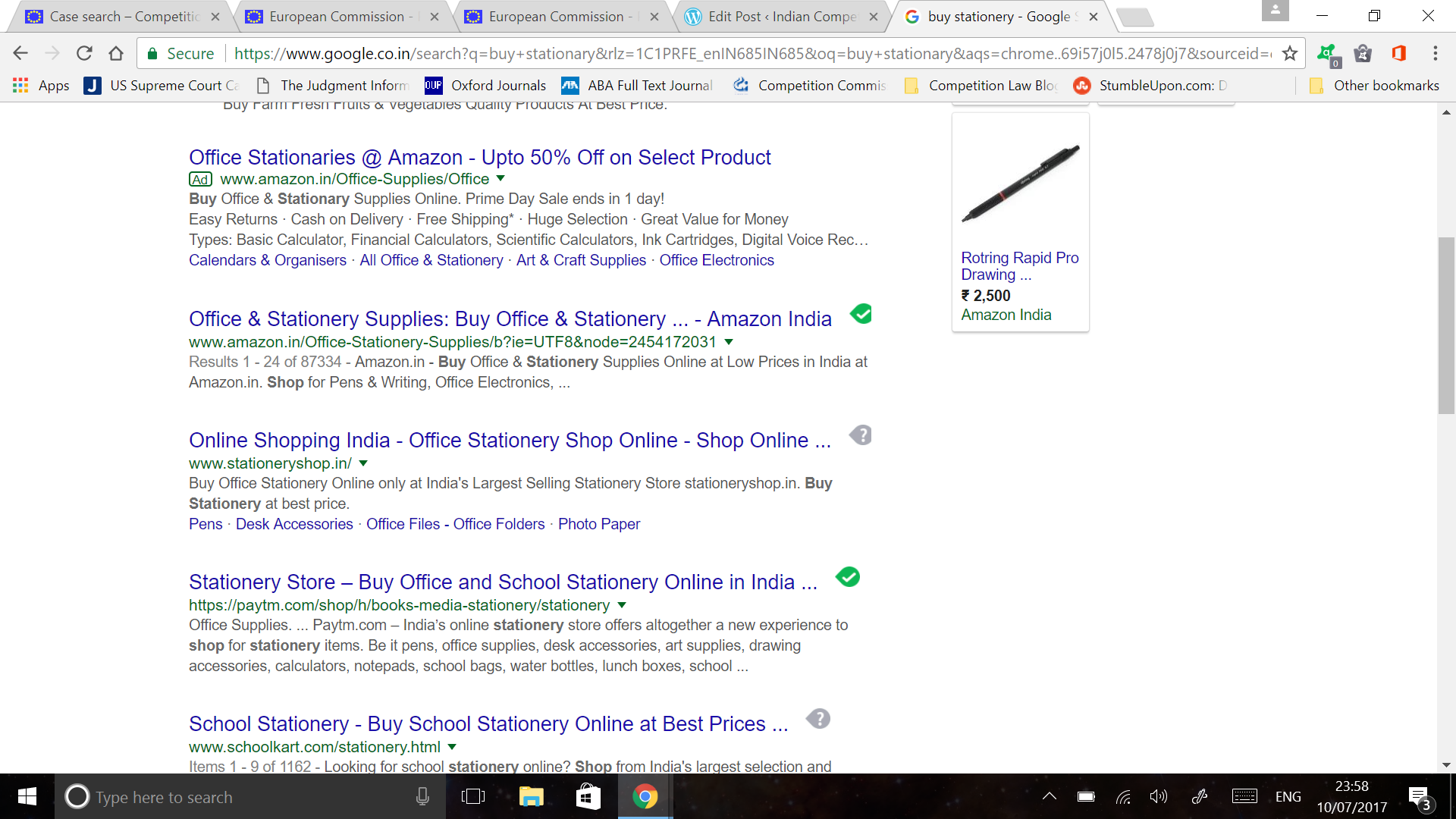
Google Shopping 2

Google Shopping 3

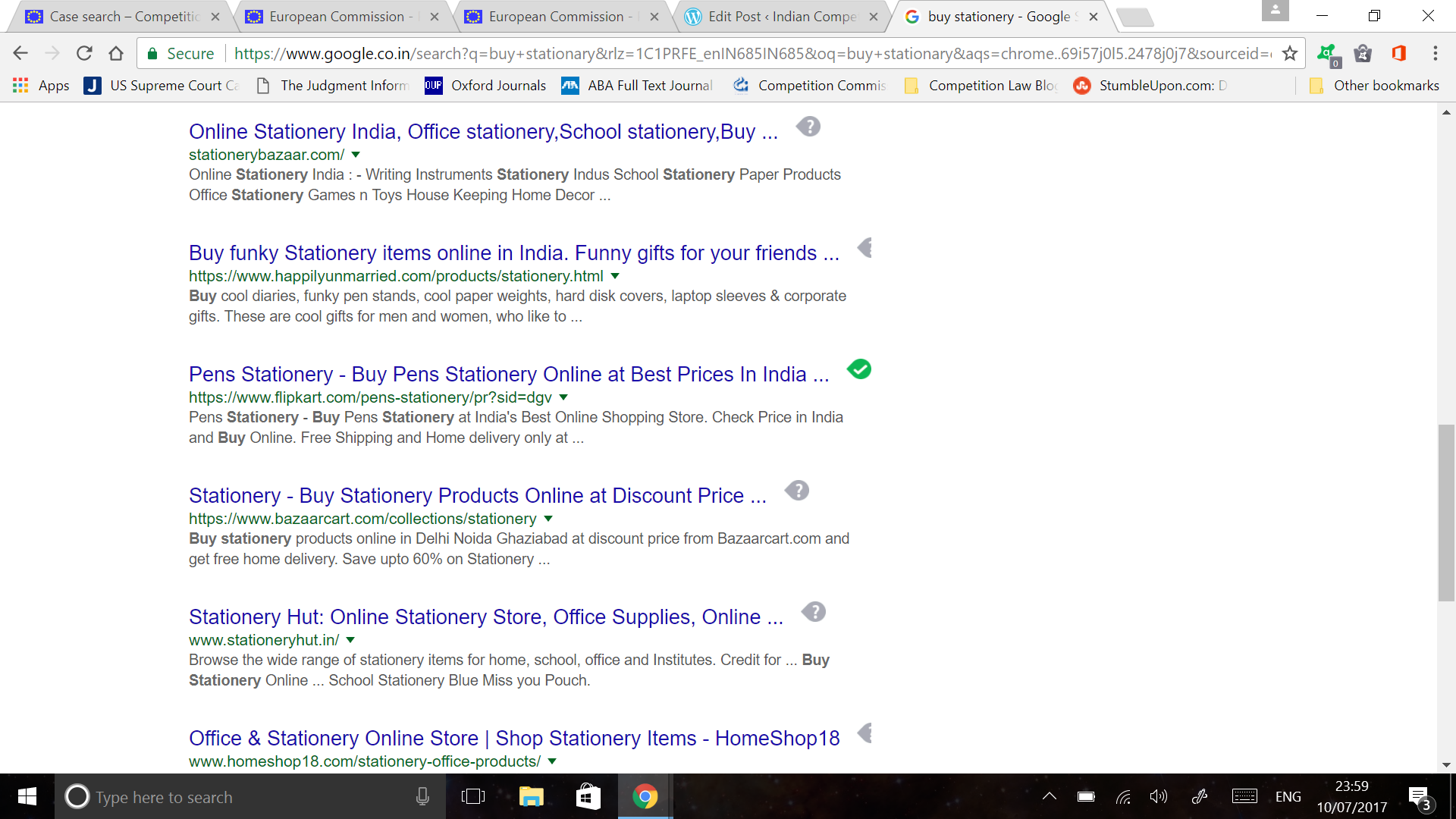
Google Shopping 4

(Above: Google Shopping India: Personal experience on experimentation.)

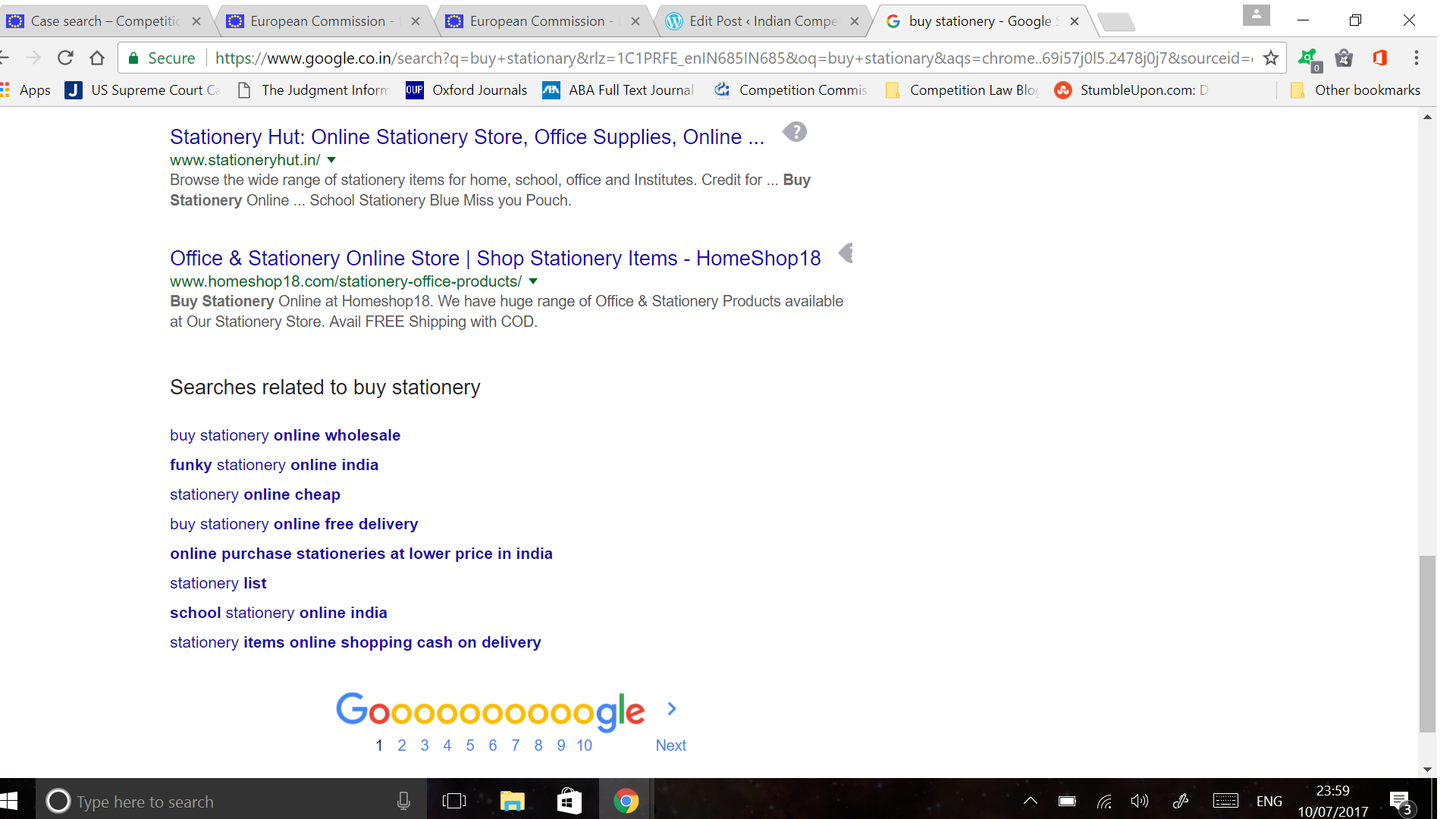
2. From the above, the relevant market as per the Commission appears to be that of “shopping comparison websites/services”. The question to ask is, is there really such a definitive market in existence ?? Somehow, no matter which way one tries to describe it, it appears to be hard to cogently define it. After all, comparison of products can be done through the regular search, or they can be done through the individual websites, or they can be done through individual Applications (in the case of smartphones). Personally, I hardly used the Google results which appeared on the side. I (and perhaps many others) end up directly clicking on the “trusted/preferred” website (Amazon India, Flipkart, Ebay.in) and search directly for the product by jumping between these sites (not to mention to multiple options available on each individual website). It’s important to note that these website results do almost always come up among the top five to ten results on the first page, hence the lack of use of the Google Shopping. (See the pictures above as an example)

3. The fundamental premise of competition law, both in India as well as the E.U., is that any appreciable adverse affect on competition in the relevant market or abuse of dominance results in a harm to consumers. In the present case, however, was Google Shopping really so bad ?? Is there really an adverse affect on competition or an abuse of dominance ?? As already stated, the results which pop up under Google Shopping (which, it must be noted, are clearly differentiated),  are merely the most relevant websites where you would find the product. And consumers do appear to be have A LOT of choice in the alleged relevant market. So even if the sponsored results do pop up on the side, does it really hurt anybody at all ?? In fact, from the Press Release, it appears that even the Commission is not sure if there is any actual detrimental affect on consumers, but rather only states “Google’s comparison shopping service [sic] make[s] significant gains in traffic at the expense of its rivals and to the detriment of European consumers.” A rather vague statement, but then, that may be because it is only a Press Release.

Google’s troubles in Europe are far from over. The Android Operating System and the Adsense cases are still pending, and the trend appears to be against the company. The three cases together could well become the triumvirate against what was once considered (and arguably still is), the most innovative company in the world.

Société Coopérative de Production SeaFrance SA v The Competition and Markets Authority and Another, [2015] UKSC 75

Supreme-Court-of-UK-001


I just came across an interesting Judgement by the Supreme Court of United Kingdom on mergers delivered recently on 16.12.2015 titled Société Coopérative de Production SeaFrance SA v The Competition and Markets Authority and Another, [2015] UKSC 75 (Hat tip to SCC Online) wherein it has been observed that the merger control provisions of the Enterprise Act, 2002 are not limited to the acquisition of a business that is a “going concern” but would include even the acquisition of the assets of a defunct business. According to the Court, An enterprise is subject to merger control if the capacity to perform those activities as part of the same business subsists.”


BACKGROUND TO THE APPEAL

SeaFrance SA, a French company, operated a ferry service between Dover and Calais until it ceased operations on 16 November 2011. It was formally liquidated on 9 January 2012, and most of its employees were dismissed. Groupe Eurotunnel SA (“GET”), the parent company of the Group operating the Channel Tunnel, and Société Coopérative De Production SeaFrance SA (“SCOP”), a workers’ co-operative incorporated by a number of former SeaFrance employees to secure the continuance of the ferry service, acquired substantially all of SeaFrance’s assets on 2 July 2012. This included three of the four SeaFrance vessels, trademarks, IT systems, goodwill and customer lists. GET and SCOP resumed ferry services on 20 August 2012 through GET’s subsidiary company, MyFerryLink SAS. The vessels were operated by employees who had almost all worked for SeaFrance. The reemployment of those employees had been incentivised by a statutory Plan de Sauvegarde de l’Emploi (known as the PSE3), by which SeaFrance’s parent company SNCF would provide payments to employers for employing ex-SeaFrance employees.

The acquisition was referred to the Competition Commission, the regulator at the time. It concluded that there was a “relevant merger situation” for the purpose of the merger control provisions of the Enterprise Act 2002, which could be expected to result in a substantial lessening of competition in the cross-Channel market. The “enterprise” of SeaFrance continued since its “activities” continued, even though there had been a hiatus of over seven months in its operations. The Commission imposed restrictions on the operation of the service by GET and SCOP, including a ban on using the exSeaFrance vessels for ferry services from Dover for 10 years. On appeal to the Competition Appeal Tribunal, the Tribunal gave guidance on the meaning of “enterprise” in the Eurotunnel I judgment, and remitted the question of jurisdiction back to the new regulator, the Competition and Markets Authority.

Upon the remission, the Competition and Markets Authority (which had assumed the functions of the Commission) considered that what had been acquired was an “enterprise”, and therefore that a “relevant merger situation” existed. Accordingly they confirmed the restrictions previously imposed by the Commission. That decision was upheld by the Competition Appeal Tribunal in the Eurotunnel II judgment.

The Court of Appeal allowed an appeal by a majority, holding that GET and SCOP had not acquired an “enterprise”, but only the means of constructing a new (but similar) one. In particular, this was because they had not acquired SeaFrance’s crews. They concluded that it was irrational for the Competition and Markets Authority to reach any other conclusion on the facts.


REASONS FOR THE JUDGMENT

The merger control provisions of the Enterprise Act 2002 are not limited to the acquisition of a business that is a “going concern”. The possession of “activities” is a descriptive characteristic of an enterprise under the Act. An enterprise is subject to merger control if the capacity to perform those activities as part of the same business subsists. [32-35]

The test is one of economic continuity. An Acquirer acquiring assets acquires an “enterprise” where (i) those assets give the Acquirer more than might have otherwise been acquired by going into the market and buying factors of production and (ii) the extra is attributable to the fact that the assets were previously employed in combination in the “activities” of the target enterprise. The period of time between cessation of trading and acquisition of control of the assets may be a relevant factor, but is not necessarily decisive. [36-40]

This was substantially the same principle set out by the Competition Appeal Tribunal in Eurotunnel I, which the Competition and Markets Authority applied in this case. [40-41]

The Court of Appeal’s finding that the Authority’s evaluation was irrational was unjustified. GET and SCOP acquired substantially all the assets of SeaFrance, including trademarks, goodwill, specialist vessels maintained in a serviceable condition, and substantially the same personnel. The Authority’s conclusion that this demonstrated “considerable continuity and momentum” and “the embers of an enterprise”, which could be passed to GET and SCOP, was unimpeachable. The order of the French Court of 9 January 2012 to dismiss the employees did not disrupt that continuity and momentum because the order was made on terms that the PS3 preserved the prospect of employment on the ships for the dismissed crew members. [41-43]

The majority of the Court of Appeal was wrong to narrow the question of economic continuity to the legal effect of the decision of the French Court in January 2012 and whether this terminated the employment relationship between SeaFrance and its employees. The Competition and Markets Authority is not entitled to any special level of deference: the test for determining whether there is a “relevant merger situation” and relevant “activities” is a legal question. [31] But the Authority undertook a broader economic analysis, concluding that there was economic continuity. That evaluation was complex and sensitive to a whole range of factors. It was not a purely legal enquiry. Its economic analysis should be respected. [44-45]

References in square brackets are to paragraphs in the judgment


When one goes through Section 5 of our own Competition Act, 2002 as well as the definition of the term “Enterprise” under Section 2(h) of the Act, there appears scope for a similar dispute to arise in our own jurisdiction in the future. The definition of the term “Enterprise” under Section 2(h) also does not contemplate any such merger or acquisition of a defunct organisation. Yet, this happens on a frequent basis in the Indian corporate sector, albeit since individual transactions are on scales relatively small, they avoid triggering the C.C.I. combination process.