The Big Bang Tech.


71Afo54hfeL._SL1500_

Things in the media have become typically quiet after the initial flurry of headlines, and as usual, I was supposed to write a lengthy blog post on the antitrust actions against Big Tech , and as usual, it kept getting delayed to the extent that it has now become an exercise in futility. (Man I need to get more disciplined with my writing !! )

So to just bring this to the closure in my own head more than anything else, here is a list of the major and most informative headlines (in no particular order of importance) on the issue:

Silicon Valley pressured as Washington turns up antitrust heat

Unheard for years, smaller fished finally get a say against tech sharks.

On priority: Regulating online giants for financial viability of news business

Senator Warren urges antitrust chief to recuse himself from Google, Apple probes

Four reasons why antitrust actions will likely fail to break up Big Tech

Regulating or breaking up Big Tech: an antitrust explainer

Information Manipulation: An Important Side Note of Network Neutrality

attention_manipulation


Freedom of Speech and prevention of a “walled garden” have been one of the prime arguments for network neutrality since the inception of the contest. Expanding on this argument, a side note to also be taken into consideration is the information manipulation which has come to be highlighted since the election of Donald Trump, where the particulars of the information “allowed” to be brought in front of you “help” you to make “your” decision accordingly.

Facebook can be an excellent example to help understand this argument for two reasons. Firstly, it came up with the extremely controversial (but still operational in some countries) FREE BASICS programme. Secondly, it is without a doubt one of the, if not THE most accessible websites on the internet (Google may be the only serious rival, but since Google in my opinion can today be considered a full fledged platform integrated over multiple websites as well as the Android OS rather than just the regular Google website, we’ll stay out of this debate for now and keep it simple.)

Facebook has of course been facing flak in the U.S. over its alleged contribution to last years presidential election, but what it actually more of a worry is the abuse of it’s service in communities outside the U.S., particularly Asia. We’ve partially discussed such issues before on this Blog (see here and here), but the latest example is that of Myanmar, where the rise of Anti-Rohingya sentiment seems to have coincided with a huge boom in the use of social media, a large chunk of which is attributable to Facebook itself. Why ?? Because in 2016, Facebook partnered with MPT, the State run telecom company, to give users access to its Free Basics Programme.

This is not to insinuate that Facebook is directly attempting to control the world and actively working with state regimes to incite hatred against minorities and in all fairness, the issue is excruciatingly complicated, but since Facebook dominates the Social Media space (along with Instagram and WhatsApp), the potential for abuse of its Free Basics programme becomes all the more potent. To quote from a recent article:

“Facebook is not directly responsible for violent conflict, of course, and viral
misinformation is hardly unique to its services. Before social media, there were email hoaxes and urban legends passed from person to person. But the speed of
Facebook’s growth in the developing world has made it an especially potent force
among first-time internet users, who may not be appropriately skeptical of what they see online.”


Fast Track Call Cab Pvt. Ltd. and Anr. v. ANI Technologies Pvt. Ltd., Case No. 6 and 74 of 2015

uber-ola

download

There are certain cases in any area of jurisprudence in law, including competition law, which tend to make an individual mark of their own. This may be simply due to the parties involved, or because the cases involve seminal questions in law which would help clarify the legislation involved for future use, or because the ramifications (not necessarily negative) of the Final Order go beyond just the law involved, and into the arena of a change in the very economics or social structure of the system the case may question.

In my personal opinion, Fast Track Call Cab Pvt. Ltd. and Anr. v. ANI Technologies Pvt. Ltd., Case No. 6 and 74 of 2015 falls into this category and for all the reasons stated above.

My criticism of past Orders of the Commission through this Blog is well known, but this time, I must bring on record my appreciation. The Final Order is by no means perfect or maybe even completely legally sound in all aspects, but it does display not only the growing maturity of competition jurisprudence by the Commission, but also at least an attempt by the D.G. to not be content with a superficial investigation of  relevant market dynamics.

Both Ola and Uber have already suffered enough regulatory troubles regards surge pricing and driver registration from various transport departments across the country, and though Ola has won this round, there will most probably be an Appeal. But the biggest fallout for Ola (and even Uber), which in my personal opinions has made it a pyrrhic victory, is that the D.G. and the Commission have extensively written about the below cost pricing strategies adopted by both companies. In fact, the D.G. has gone so far as to note that the significant market share of Ola or Uber has nothing to do with technological innovation but is rather the pure consequent of below cost pricing. Whether the companies like it or not, it is probable that both Ola and Uber will be prodded to bring down the revenue drain, not just by investors but also by competitors and various state departments as economically, a market providing services below cost can under no circumstances be considered an economically sound market, and creates potential avenues for future investigations by the Commission.

COLLECTIVE DOMINANCE BACK IN THE LIMELIGHT

An alternative argument which was raised by the Informants while objecting to the D.G. Report was that there is a possibility of two entities exercising dominance at the same time. The Informants claimed that the analysis of the D.G. pointed towards the presence of more than one dominant player in the relevant market. Furthermore, they submitted that the D.G. in its report had admitted the growth of both Ola and Uber was not the result of any technological innovation or efficiency but the result of a practice to charge substantially below the average variable cost. The Informants also quoted the observations of the Canadian Competition Tribunal in the Visa Mastercard Case, which noted that both MasterCard and Visa can individually possess market power in the relevant market. It was thus submitted that a conclusion of simultaneous dominance of Ola and Uber was not incompatible with the provisions of the Competition Act, 2002.

I have already on a number of occasions discussed Collective Dominance (See here, here and here) and how it is not presently recognised under the Act. The Commission’s reasoning is similar to what we have already propagated here and I have nothing new to add in this area.

However, for the fun of it, let us hypothetically presume that Collective Dominance was recognised under the Competition Act. Could Ola and Uber have been held liable for abuse of dominant conduct ?? I would submit the answer would still be a no. 

Firstly, since the Uber investigation has been stayed by the Supreme Court, no finding or penalty could be imposed upon Uber. But beyond that, secondly and more importantly, is that Ola and Uber would never be able to breach the threshold for Collective Dominance under Competition Law, and to  understand why one needs to look into the case of U.S.A. v. VISA Et al., 344 F.3d 229 (United States Court of Appeals, second Circuit.). Similar issues were raised against VISA and Mastercard. To summarise, the United States Department of Justice brought enforcement action against the two payment card networks and licensor of one payment card brand, alleging that governance duality between networks and networks’ exclusivity rules were agreements in restraint of trade in violation of Sherman Antitrust Act. Challenging the organizational structure of two of the nation’s four major payment card systems, the complaint charged that MasterCard and Visa U.S.A., which are organized as joint ventures owned by their member banking institutions,conspired to restrain trade in two ways: (1) By enacting rules permitting a member-owner of one to function as a director of the other (an arrangement the government described as “dual governance”) (Count I); and (2) by enacting and enforcing “exclusionary rules,” which prohibit their member banks from issuing American Express (“Amex”) or Discover cards (Count II).

The Court held that Visa U.S.A. and MasterCard violated the Sherman Antitrust Act by enforcing their respective versions of the exclusionary rule, barring their member banks from issuing Amex or Discover cards. The Court further held that Visa International, which owns the Visa brand, licenses it to Visa U.S.A., and exercises certain governance powers over Visa U.S.A., was liable for participating in Visa U.S.A.’s violation. Factually, it is important to note that a member of either the Visa U.S.A. or MasterCard network could also be a member of the other network. Thus a bank that was a member of Visa U.S.A.’s network and issued Visa cards could also be a member of the MasterCard network and issue MasterCard cards. On the other hand, both MasterCard and Visa U.S.A. had promulgated rules that prohibited their members from issuing American Express or Discover cards. Evidence was also cited that atleast three major U.S. issuer banks would have contracted with American Express to issue Amex cards in the United States but for the exclusionary rules.

In other words, in Visa Mastercard, there was active collusion between the two entities to limit market access to the other two competitors, whereas in the case of Ola and Uber, it is anything but !! Both companies are constantly at each other’s throats on pricing and volume of rides in the country. We are starting to see a cut back on the below cost pricing strategy, but only a continual market watch on the sector will help to gather enough data to understand the consequent effects, and it is too early to take a firm decision as of today. Since Ola and Uber have together effectively turned the market as  one heavily based on network effects,  strong competition and constant change in market share might be the norm between the two for some time to come.

POST SCRIPT: UBER IN INDIA 

The Uber legal team would have been on their tenterhooks till this Order came out, and will be studying it closely (the investigation against Uber has been stayed due to questions of law regarding the powers of the erstwhile Competition Appellate Tribunal (COMPAT) and the matter is presently pending in the Supreme Court). The relevant market would obviously include Uber, and the D.G./Commission made a number of observations regarding the company, such as:

1. “…[i]n the first six months of 2015-16 (till September 2015), the D.G. noticed that while OP’s market share increased from marginally by 2% to 3%, Uber’s share increased at a faster rate i.e. by about 20%-22%.” [This is definitely due to a lower base rate.]

2. “It was further noted that from March 2015 onwards, Uber has maintained the second position. The D.G. also noted that from January to September 2015, Uber’s trip size registered growth of nearly 1200%, while OP’s growth has been about 63% during the same period.” [Same reason as above.]

3. “The D.G., thus, noted that backed by its marketing technology and logistics and financial support, Uber was able to successfully counter the pricing strategy of OP, and being able to sustain losses, which restrained OP from exercising market power in the relevant market. This was evident from the fact that similar strategy was followed by Uber and as a result, the gap in market share between OP and Uber narrowed down from 69% in January 2015 to 22% by September 2015.”

4.  “Further, with the steady increase in Uber’s market share from 6 – 7% in January 2015 to 36-37% in September 2015, it could not be said whether OP would be in a position to hold on to its market share for a sustainable period for assessment of dominance in the relevant market.”

5. “Thus, D.G. opined that both OP and Uber have adopted ‘below-cost pricing strategy’. However, since the scheme of the Act only attracts the provisions of Section 4 when an incumbent is found to be dominant, the D.G. stated that OP can be said to have
indulged in abuse by way of predatory pricing, only if it is found to be dominant in the relevant market. Since OP was not found to be dominant, the D.G. concluded that OP did not contravene the provisions of Section 4 of the Act.” [Emphasis added]

6.  “On the other hand, Uber, which entered the relevant market in 2013-14, expanded its network rapidly to account for nearly one third of the active fleet in the relevant market in 2015-16. In terms of annual number of trips, its share increased from 1 – 2% in 2013-14 to 30-31% in 2015-16.” 

7. “…[U]ber, entered the relevant market in the year 2013 and garnered a sizeable market share in just about two years’ time. In terms of number of trips on monthly basis, its share increased from 0-1% in August 2013 to 36-37% in September 2015. Further, Uber showed a steady growth February 2015 onwards, with its share in terms of monthly number of trips having increased from 6-7 % in January 2015 to 36-37% by September 2015. Its entry as well as steady growth during the period of investigation shows that the market was evolving. While Uber’s entry, as the Informant has argued, did not dislodge OP during the period of investigation, OP’s declining market share post January 2015 reflects the competitive constraint posed by Uber and the fragility of leadership position in a dynamic business environment, as discussed earlier.” 

8. “As a matter of record, in the present case, OP does not have an edge over all its competitors in terms of the size and resources. Interestingly, the investigation revealed that that Uber Inc., which is the parent company for Uber had a total capital investment of about 15 to 20 times of OP’s financial resources.” [The C.C.I. doesn’t seem to have made much of this, but it is important to note that “size and resources of the enterprise” and “economic power of the enterprise including commercial advantages over competitors” are two of the factors to be taken into consideration during an inquiry under Section 19(4)(b) and Section 19(4)(d) of the Act respectively.]

All this goes to show that Ola may owe Uber one for its victory, and also that Uber will be fully focused to ensure a favourable outcome in the Supreme Court to avoid the cross hairs of the D.G./C.C.I.

Network Neutrality: An Update

loading


Yesterday (30.08.2017) will be marked as a watershed day by observers for Network Neutrality. The issue is being hotly contested in arguably the world’s most capitalistically advanced jurisdiction for telecom and the internet (U.S.A.) as well as the jurisdiction with potentially the biggest telecom and internet market, both by the number of users as well as revenue (India) and yesterday was an eventful day in both.

In India, the Telecom Regulatory Authority of India (T.R.A.I.)  held and concluded an Open House Session in New Delhi on the issue of Network Neutrality. Unfortunately, being bed – ridden with a fracture, I was unable to attend it myself, but I am informed that all parties were “extremely vocal” with their opinions. T.R.A.I. is likely to publish its recommendations by October. On a side note, Certain telecom companies also complained against SIM-locked handsets coupled with a tariff plan and said that a limited access to certain applications through such devices was as good as a “walled – garden” and against Network Neutrality (No prizes for guessing who they’re talking about).

At the opposite end of the globe, yesterday was the last day to file comments on the Federal Communications Commission plan to deregulate broadband service and roll back net neutrality rules, and at least 21.9 million comments have been confirmed to have been received. Voting by the F.C.C. on the issue is not expected anytime soon, as the Commission is known to take it’s time with decisions after such commentary periods.

Here’s to waiting and watching and hoping for the best.

C.C.I./T.R.A.I. and Flashbacks to Old Posts

collage-inside-CCI-TRAI-1

The recent C.C.I. – T.R.A.I. jurisdiction conflict regarding tariff investigations reminded of an old post which was written a long time ago. Those were very early days for the Competition Act and the C.C.I., but a theoretical conflict was spoken off even then. Personally, I find it surprising that it took so long for a dispute between the two to come to the fore, but without a doubt, sooner or later, it was bound to rear its head.

The old posts can be found here and here. I have nothing more to add, except factually, the C.C.I. appears to have failed to hold its own in Court when it’s jurisdiction came to be challenged regards the C.E.R.C. and the P.N.G.R.B. The P.N.G.R.B. Case was pending even at the time the previous posts were written, but subsequently fell below the radar. Surprisingly, neither of the Judgements (the C.E.R.C. Case or the P.N.G.R.B. Case) can be found. Please do post a link in the comments in case you find them or have access to them.

Case No. COMP/C-3/39.740, COMP/C-3/39.775 & COMP/C-3/39.768 – The 2.42 Billion Euro Google Order.

P034802000402-605061


So it’s finally out, and boy is it big !! Well….actually….For Google(Somehow, still can’t bring myself to call it Alphabet. The word is so synonymous with the search engine since times immemorial), monetarily, it’s probably small. 2.42 Billion Euros is peanuts for the Internet behemoth. But what does matter to it is the impact this is going to enough on its products and services not just in the E.U., but throughout the world, which is why it is safe to bet that the company is going to all the way up to the E.C.J. if it has to. Fighting it out is already a forgone conclusion.

So, the following is my preliminary understanding of the Order. Please note though, that the complete text of the Order is not yet out, and so my preliminary opinion is based upon the Press Release, the Fact Sheet, and the Timeline of the case.:


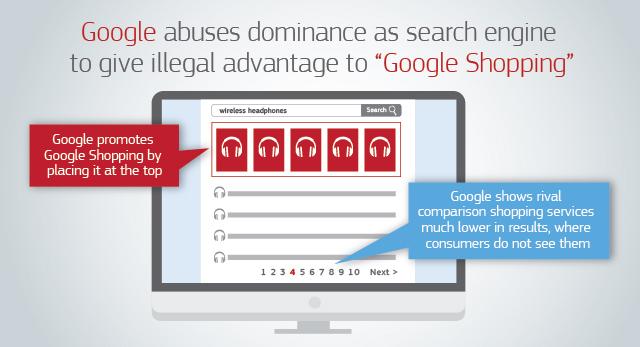
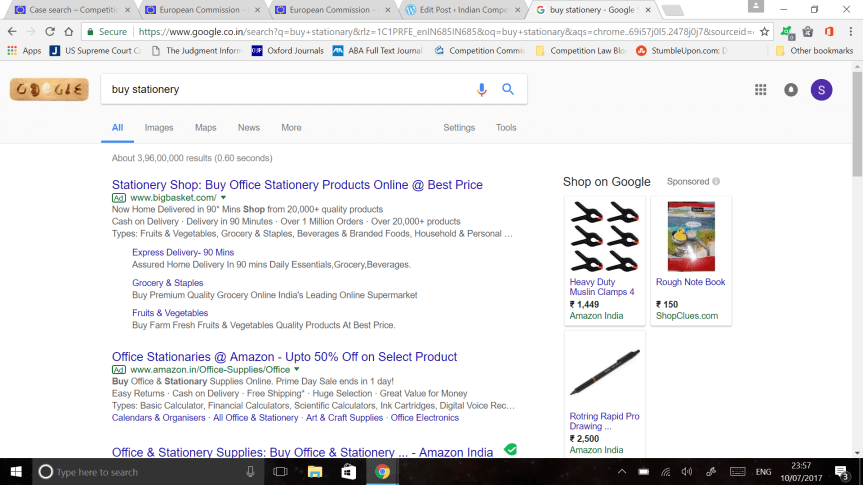
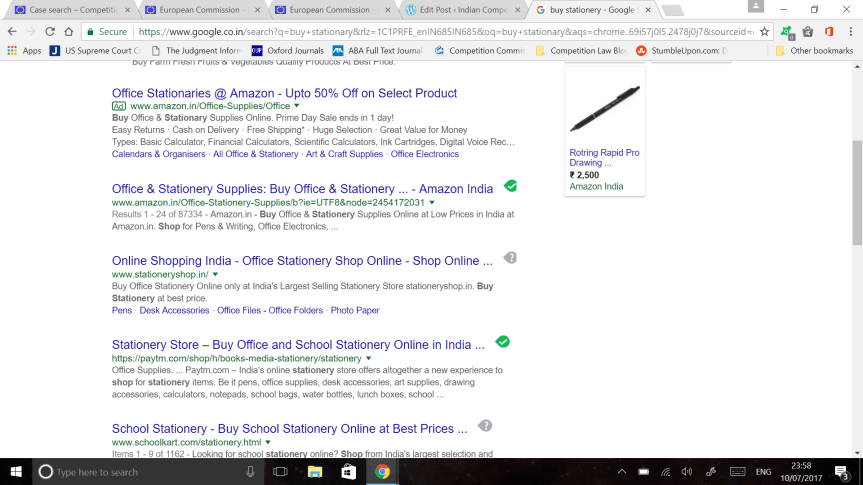
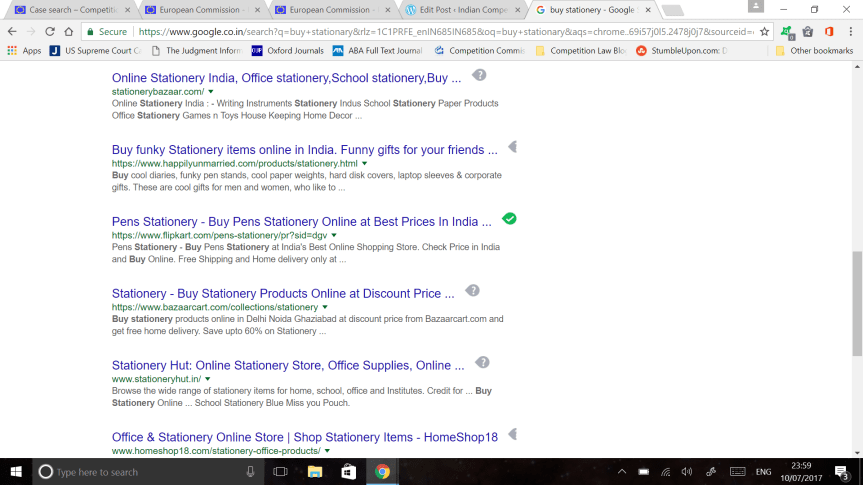
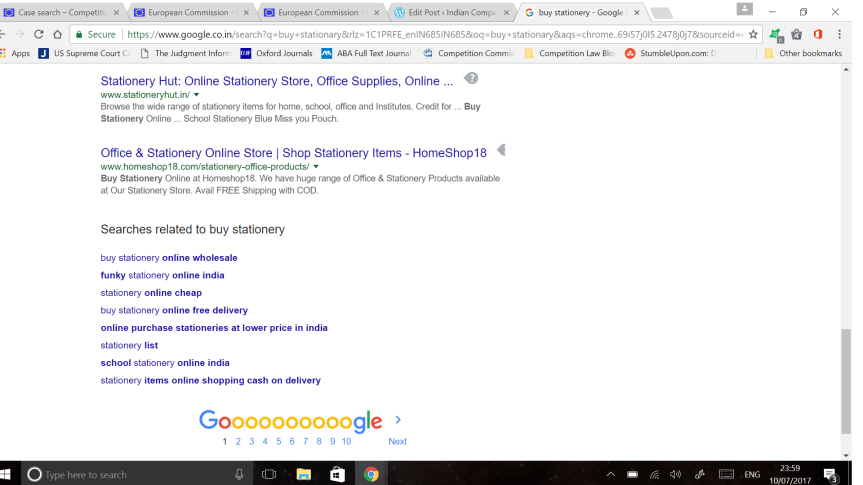
1. The case concerns the display of products on a service called Google Shopping. Now since this service has not been rolled out in India till now, I have never personally had a chance to use it, but from what I have to come to understand (and do feel free to correct me if my understanding is wrong), the product “allows consumers to compare products and prices online and find deals from online retailers of all types, including online shops of manufacturers, platforms (such as Amazon and eBay), and other re-sellers.” (Update: Okay so I just realised that the words typed matter. They must indicate ones intent to purchase a product. So the service has been rolled out in India, but after some experimentation, the results appear to be limited.)

Google Shopping 1


Google Shopping 2

Google Shopping 3

Google Shopping 4

(Above: Google Shopping India: Personal experience on experimentation.)

2. From the above, the relevant market as per the Commission appears to be that of “shopping comparison websites/services”. The question to ask is, is there really such a definitive market in existence ?? Somehow, no matter which way one tries to describe it, it appears to be hard to cogently define it. After all, comparison of products can be done through the regular search, or they can be done through the individual websites, or they can be done through individual Applications (in the case of smartphones). Personally, I hardly used the Google results which appeared on the side. I (and perhaps many others) end up directly clicking on the “trusted/preferred” website (Amazon India, Flipkart, Ebay.in) and search directly for the product by jumping between these sites (not to mention to multiple options available on each individual website). It’s important to note that these website results do almost always come up among the top five to ten results on the first page, hence the lack of use of the Google Shopping. (See the pictures above as an example)

3. The fundamental premise of competition law, both in India as well as the E.U., is that any appreciable adverse affect on competition in the relevant market or abuse of dominance results in a harm to consumers. In the present case, however, was Google Shopping really so bad ?? Is there really an adverse affect on competition or an abuse of dominance ?? As already stated, the results which pop up under Google Shopping (which, it must be noted, are clearly differentiated),  are merely the most relevant websites where you would find the product. And consumers do appear to be have A LOT of choice in the alleged relevant market. So even if the sponsored results do pop up on the side, does it really hurt anybody at all ?? In fact, from the Press Release, it appears that even the Commission is not sure if there is any actual detrimental affect on consumers, but rather only states “Google’s comparison shopping service [sic] make[s] significant gains in traffic at the expense of its rivals and to the detriment of European consumers.” A rather vague statement, but then, that may be because it is only a Press Release.

Google’s troubles in Europe are far from over. The Android Operating System and the Adsense cases are still pending, and the trend appears to be against the company. The three cases together could well become the triumvirate against what was once considered (and arguably still is), the most innovative company in the world.

And Here We Go Again….

download


The European Union has launched a fresh salvo against Google, this time charging Google with abusing its dominance in Internet searches and opened a probe into its Android mobile system.


The E.U. Executive Commission has stated that it has found that Google “gives systematic favourable treatment” to its Google Shopping at the expense of others in its general search results.


Am pretty sure by the time the Google anti-trust investigation ends, one will be able to write an entire book on the company and its competition law troubles.

There IS a Better Way to Call India: A Quick Comment On Competition Law And Advertising.

Airtel-Talk

In all the chaotic hullabaloo which arose on Airtel’s VoIP Data charges issue (detailed article on the issue currently in progress), another protest which drew comparatively little attention (probably due to the substantially lesser individuals/entities it affected) was the protest by International Long distance(I.L.D.) Operators against the Company’s practice of advertising it’s own VoIP Application Airtel Talk over long distance calls. Specifically, a few seconds before connecting the call.

I am a total outsider to the precise details of the case, and the facts are also disputed (I.L.D. Operators claim the advertisement was run selectively only on those networks with whom Airtel had not entered into collaboration agreements. Airtel denies this and claims that the advertisement was played on all networks equally without any discrimination.) But it did get me thinking on the issue of Advertising in Competition Law.

Prima-facie, one would consider advertising and competition law as congruous to each other. After all, advertising is an essential part of the competitive process in any economy. If a consumer is not aware as to what goods and services are on offer and at what price they are on offer, he or she will be unable to choose between the suppliers of the goods or services, and therefore, competition between suppliers may get diminished. But in this imperfect and admittedly anti-competitive world that we live in, it never is that simple. There are two different scenarios which need to be considered while addressing the issue of advertising and competition law.:

Individual Advertising

Individual Advertising is what I referred  to above, i.e., an individual entity choosing to advertise it’s products with the aim to grab market share from competitors in the same sector. This would generally not be subject to perceived anti-competitive harm. Misleading and false advertising, including comparative advertising, may be concerns, but in India they would dealt before other fora. There is however some literature which suggests that advertising paradoxically carries with it an inherent anti-competitive effect as advertising costs act as a serious barrier to the entry of new entities wishing to enter a market which is already dominated by a few relatively large competitors, especially in markets which inherently require enormous amounts to be spent in building up a brand name for the product/company. In fact, Bork has even gone so far as to state that it should be considered as a Barrier to trade !! (See Robert H. Bork, The Antitrust Paradox.)

Horizontal Agreements on Advertising

This refers to agreements among competitors in a market, and needless to say, these are a bit problematic. Any agreement among entities which restricts advertising would generally be considered as an anti-competitive agreement.

However, the reaction of the European Commission (E.C.) has been mixed depending upon the facts and circumstances of each case. While in the case of Belgian Roofing Felt, OJ [1986] L 232/15 (later upheld on Appeal in Belasco v. Commission, [1989] ECR 2117) the Commission ruled against joint advertising which led to a uniform image of products in a market wherein individual advertising would have facilitated differentiation, and consequently competition, on the other hand, in Re CECIMO, OJ [1969] L 69/13 and UNIDI, OJ [1984] L 322/10 (later upheld on Appeal in ANCIDES v. Commission, [1987] ECR 3131), it was accepted that it is sometimes desirable to rationalise and coordinate advertising efforts while imposing certain conditions on such coordination.

Post Script: The Advertising Market

As a post script, other than the above, an important area where competition needs to be maintained is the advertising market itself. It is important that the advertising media itself should function in a competitive manner free from any anti-competitive practices, including (but not limited to) any practice which might lead to reduction of advertising space in the market. This has been affirmed in the U.S. as far back as 1951 in Lorain Journal Co. v. United States, 342 US 143 (1951). One such allegation has already arisen before the C.C.I. is the case of Advertising Agencies Guild v. Indian Broadcasting Foundation, Case No. 35 of 2013. Though that particular Information was closed, the currently running Google Investigation before the C.C.I. involves similar issues (among others) and one will have to wait and watch for further competition law developments in this area.