CCI Banking Cartel Order – Where do we go from here ??

If the CCI wanted to inaugurate its adjudicatory functions with a bang, well then it certainly did!! Though looking back, they probably would have preferred a less noisy cracker (read: controversial) first order.

In the matter of Neeraj Malhotra v. Deutsche Bank and Ors., the CCI analyzed the issue of whether pre payment charges levied on customers by banks and other home loan institutions were an anti – competitive agreement and resulted in an abuse of dominant position. In its order, the CCI reached the conclusion reached the conclusion that such charges are not anti – competitive and that there has been no abuse of their dominant position by the institutions.

Specifically, the following issues were framed before the commission:

  1. Whether there is an agreement amongst the institutions to impose changes?
  2. Whether there is an appreciable adverse effect on the market due to the levying of charges?
  3. Whether there is an abuse of dominant position by the institutions?
  4. Whether the changes levied impose an additional cost on customers?

I personally feel that the last issue was redundant in the present matter. However, for the sake of discussion, I shall proceed on the assumption that it is a valid question which was raised.

To summarise the order, the majority opinion (the order was decided by a majority of 3:2) rejected the contention that the institutions acted in concert and had an agreement to impose charges. It also observed, as a continuation to the above issues, that the levying of charges on the consumers has no impact on the relevant market, i.e. the home loan market in India, thereby restricting competition. On the issue of abuse of dominant position, the CCI noted that no single institution in India has the capability of operating independent of the competition or affecting consumers in his favour. As regard the last issue, the CCI observed that the institutions do suffer a cost when a borrower opts to pre – pay his loan. It felt that it would not be correct to look at the matter only form the point of view of the consumer and that the interests of the consumer cannot be protected at the cost of the service provider. The full text of the order can be found here.

At the very outset it is submitted that I firmly disagree with the views expressed by many that the CCI should look exclusively at the effect of an agreement on the competition within the relevant market and not express opinions or render judgements on a consumer impact criterion. Other than the well known fact that anti – trust mechanisms and consumer protection are intrinsically connected, the preamble of the Act itself provides for the protection of the interests of consumers in the relevant market and this intention is further enforced on a bare perusal of Sections 3, 4 and 18, all of which provide for consumer interest to be taken into consideration.

Coming to the order itself, there does not seem to be any fault in the reasoning of the majority Bench. However, what is interesting is the fallout which this order may have for the working of the commission in the future. More specifically, in the application of the rule of reason to decide whether or not a particular agreement is anti – competitive in nature. While in the present matter there may not have been conclusive evidence to prove the existence of an active cartel, one can wonder where and when the commission intends to draw the line on application of the above mentioned rule. It seems to have impliedly, through this order, given its assent to agreements which may appear broad in nature and which may not be entered into with a per se intention to form a cartel and to abuse a dominant position, but which may, consequently result in an adverse effect to competition in the relevant market, i.e. in the present case, the agreement to levy charges, as long as the imposition of such charges do not give the appearance of an active coordinating cartel. One may take the argument that by applying this interpretation of the rule of reason, many anti – competitive agreements may circumvent inspection as they may appear to be harmless for the relevant product/service market. However, taking into consideration the infancy of Indian competition jurisprudence, it is best to simply wait and watch to see the after effects of this order.   

And I Thought My Jokes Were Bad….

Much has been said about the notification empowering the Competition Commission with its full merger control powers (as usual, I am late in publishing this post. I really must learn to be more punctual with this blog). To summarise, “the Central Government hereby appoints the 1st day of June, 2011 as the date on which Sections 5, 6, 20, 29, 30 and section 31 of the said Act shall come into force.”

However, the same notification also exempts, “in public interest”, the “group” exercising less than fifty percent of voting rights in the other enterprise from the provisions of Section 5 of the Act for a period of five years. At the same time, the Central Government has also again, “in public interest”, exempted an enterprise, whose control, shares, voting rights or assets are being acquired has assets of the value of not more than 250/- crores or turnover of not more than 750/- crores from the provisions of Section 5 of the said Act for a period of five years.

While what construes as “public interest” is subject to interpretation by the reader, what is not subject to interpretation is the fact that the exemptions more or less render the notification of the above mentioned sections, particularly Sections 5 and 6, worthless and as good as not having been notified at all. In fact, when read carefully, it is evident that the exemptions are in fact, clearly NOT in public interest.

Firstly, looking at the exemption of groups, it is evident that consequent to the exemption, any such “group” as defined in the act can effectively acquire voting rights in an enterprise through stock purchase, thus controlling the company. Since the term “group” has been used under Section 5(b)(ii) of the Act, the purpose of this part, i.e., to prevent combinations of or among enterprises engaged in production, distribution or trading of a similar or identical or substitutable goods or provision of a similar or identical or substitutable service, remains unfulfilled in preventing horizontal mergers inhibitory to competition in the market and the growth of a dominance of a single group in the relevant market.

Secondly, the exemption relating to acquired enterprises in even more disastrous in consequences than the previous one. It blatantly allows a larger enterprise and one endowed with considerably large pool of resources (which most large enterprises without a doubt have) to buy out any other comparatively smaller venture which has the potential to or is already building up a competitive position in the market. The acquired enterprise having been exempted, such acquisitions cannot fall under the regulatory jurisdiction of the CCI.

An argument may be raised that any such merger or acquisition would still be subject to the procedure of approval under the Companies Act, 1956. However, with all frankness, taking into account real practice, the procedure laid down under the above act under Section 372 is not an effective mechanism to check or determine the effect of an acquisition or merger on competition in the markets. Sanctions are usually granted with little objection, and the procedure relates more to internal formalities within the companies rather than regulatory external control.

On a sarcastic note, maybe “public interest” means not the interest of the citizens of India and the Indian market, but rather the “public” government.

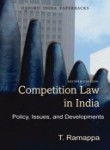
Book Review: Competition Law in India – Policy Issues and Developments by T. Ramappa

TITLE: Competition Law in India – Policy, Issues and Developments

AUTHOR: T. Ramappa

PUBLISHER: Oxford University Press, Delhi

At the very outset I would like to submit that this Book is without a doubt the best Book for those uninitiated in competition law who wish to understand the subject in a simple, yet uncompromising language. It is, as far as I am concerned, currently, the most well written Book on Indian competition law. It is also a very well laid out Book, starting with a introduction and overview about Anti – Trust laws in India, the past and present and also provides a brief history on the evolution of Anti – Trust laws in India, from the days of the MRTP Act, its short comings and its effect on the Indian market to the currently in force Competition Act, 2002. The author then speaks in detail about Anti – Competitive Agreements, Abuse of Dominant positions and Combinations (in separate chapters respectively), and then concludes with comments on the enforcement mechanisms enumerated within the Act, and the issues which may arise with respect to such enforcement. All in all, a well conceptualized Book

However, what is lacking in the Book are conclusive opinions. The author raises questions which may arise in the future or which which have already arisen in other avenues of law related to competition but fails to clearly elucidate on them. He often leaves them unanswered to the complete satisfaction of the reader and often provides what I personally feel are half hearted and unconvincing conclusions. While this may or may not have been the intention of the author, it does leave the reader unsatisfied about the knowledge he has derived after reading the Book and fortunately or unfortunately (depending how you look at it), raises more questions than answers in ones mind.

However, the above criticism should under no circumstances deter one from reading the Book. As has been already mentioned above, it is currently the best Book on competition law in India.

Jurisdiction ?? Of course we have jurisdiction ?!?! – Part 2 ( A Post Script to Part – 1)

I realised after re-reading my previous post that I failed to answer certain questions which I may be asked by readers. :

1. Why have I not commented on the currently sub – judice matter before the Delhi High Court challenging the jurisdiction of the CCI in favour of the PNGRB ??

2. Why have I not commented on the conflict of powers and jurisdictions between the CCI and COMPAT, especially after the Judgement of the Supreme Court in CCI v. SAIL ??

To answer these questions. :

1. Others far more learned than me, including Vinod Dhall, have already commented on the issue (See http://www.livemint.com/articles/2011/01/23232944/Competition-watchdog-faces-fre.html) and so I have decided to reserve my opinions on the matter till the conclusion of the suit.)

2. The previous post specifically focused on the conflict of jurisdictions faced by the CCI/COMPAT against other subject specific jurisdiction of other regulatory bodies and Tribunals. I shall be commenting on the possible fallouts of the judgement on a separate post in due course.

Hope this suffices. Please feel free to post any other questions in the comments.

Jurisdiction ?? Of course we have jurisdiction ?!?! – Part 1

A common question that has often perplexed lawyers and jurists alike is how to resolve the conflict of jurisdiction that has arisen and which is more than likely to arise in the future between the Competition Commission of India and various other subject specific Tribunals in India. The origin of the issue is very simple to analyse: you cannot under any circumstances have exclusively specific subject jurisdiction for Tribunals. It has been tried around the world and has always failed.  What is more difficult is its resolution.

Abroad, regulators rarely encounter this problem, for the simple reason that they don’t allow themselves to !! They prefer not to raise their hackles at every other regulator who may occasionally (and usually accidentally) let his dog run into their backyard. Coordination is the key to an effective implementation of laws and foreign Regulators generally seem to display a remarkably high level of maturity between themselves to resolve disputes related to conflict of jurisdiction. ( A classic example can be that of the FTC and FCC of United States).

Sadly, immaturity and inflated ego’s are two very prominent features of the Indian Bars and the executive, and so consequently, it extends to all Regulators, whether independent of governmental regulation or not, so it is doubtful considering the present state of affairs, whether they can arise a non adjudicatory resolution to the dispute.

The reason this post part has been titled as Part – 1 is because I intend to in the long run derive the correct legal jurisdiction solution between the CCI/COMPAT and all other tribunals and regulators  over time as i get time for a detailed analysis and research. in this post, I shall focus only on the inherent conflict of jurisdiction between the TRAI/TDSAT  and the CCI/COMPAT.

The issue was raised before me first during an internal moot problem prepared by a senior alumni of my Law School. I confess, I failed to find and answer to the question (specifically, what gave the TDSAT the right to pass a notice on the COMPAT, and whether they have and overriding jurisdiction over the COMPAT ??), and at that time all I could do was to pathetically avoid the question through dodging tactics and beating around the bush. (Surprisingly, the judges were impressed with it, I personally was disgusted with myself with what i considered as inadequate research). I later met the drafter of the problem and asked him for an answer to the question. He claimed that the TDSAT had a higher jurisdiction, and though I understood and accepted his logic, I admit, I was not convinced. I can now proudly claim that I have finally found the answer to the question (albeit, maybe a bit too late) and I can say with full conviction that the COMPAT has a higher authority. In fact, one will realise that there can arise no opportunity for a conflict of jurisdiction.

Section 14 of the TRAI Act, 1997 states in its proviso as follows:

“….Provided that nothing in this clause shall apply in respect of matters relating to -(A) the monopolistic trade practice, restrictive trade practice and unfair trade practice which are subject to jurisdiction of the Monopolies and Restrictive Trade Commission established under sub-section (1) of section 5 of the Monopolies and Restrictive Trade Practices Act, 1969….”

At the same time, Section 8 of the general clauses act also states:

“Where this Act, or any (Central Act) or regulation made after the commencement of this Act, repeals and re-enacts, with or without notification, any provision of a former enactment, then references in any other enactment or in any instrument to the provision so repealed shall, unless a different intention appears, be construed as references to the provision so re-enacted.”

Reading both these provisions together, one can derive a clear interpretation that since the Competition Act, 2002 repeals the Monopolies and Restrictive Trade Practices Act, 1969, a direct interpretation that arises is that the TDSAT is exempted from handling matters that the CCI and COMPAT would be competent to handle under their jurisdictions (viz. anti – competitive agreements, abuses of dominant position, combinations). accordingly, it may, under section 21 of the Competition Act, make references to the CCI regarding any matter related to telecommunications or broadcasting involving anti – trust issues.

Personally, I feel that though such clauses do clarify such vexatious questions inflicted upon various regulatory authorities and tribunals, what in fact statutes should also do is encourage harmony and coordination between the these regulatory authorities. I am happy to note that the competition Act does try to do so through section 62 which clearly states that the application of laws is not barred and that the provisions of the act are in addition to, and not in derogation of the provisions of any other law for the time being in force.

Introduction

I have been wanting to start this blog for quite some time, and the desire only grew further due to my inability to find a good comprehensive blog on Indian competition laws (an exception may be the Indian Corporate Law Blog, however, though it does have a section dealing with competition laws, it is per se a corporate law blog). What was delaying it till now was partly my busy schedule and partly my inherent laziness in taking the pains to start this new venture.

No matter, the blog is now officially active and its aim is simple: to provide a platform for reference and discussion for all those interested in the the current Anti – Trust issues affecting India and the world in general. It is hoped that though this blog makes a humble beginning, with time it shall grow into a respected platform of expression.